What Is Cuticle Aligned Hair?
When people ask, “what is cuticle aligned hair?” they are usually trying to understand why some human hair extensions feel smoother, move more naturally, and stay easier to manage than others. The answer starts with the cuticle, the outermost layer of a strand of human hair. It is made up of tiny overlapping scales that protect the inner structure of the hair. With cuticle aligned hair, the strands are collected or arranged so the cuticles generally face the same direction, from root toward tip. Keeping that direction consistent can help reduce opposing friction between neighboring strands. That does not automatically make every piece of hair premium, but it is an important characteristic when evaluating cuticle aligned human hair for extensions or other finished products.
Cuticle direction matters because hair is not simply a smooth, uniform fiber. When strands run in different directions, the raised edges of their cuticles can rub against each other. That can contribute to a rougher feel, more friction, and a greater tendency for the hair to become difficult to detangle. Proper alignment can create a smoother interaction between strands. For buyers looking at bulk hair, this is one reason suppliers and manufacturers often pay close attention to how loose hair is collected, sorted, and prepared before production. The final result still depends on many other factors, including the original condition of the hair, processing, manufacturing quality, density, texture, and how the finished hair is maintained.
It is also useful to separate “cuticle aligned” from other terms used in the hair industry. Remy hair is commonly associated with hair whose cuticles have been kept aligned, although terminology and quality standards can vary between suppliers. Raw hair generally refers to hair that has undergone little or no chemical processing, and raw hair can also be collected with the cuticles aligned. In other words, these terms describe different aspects of hair rather than being perfect substitutes for one another. A product can be raw and cuticle aligned, for example, while “cuticle aligned” by itself does not tell you everything about whether the hair is raw, colored, chemically treated, or otherwise processed.
For anyone buying extensions, the practical takeaway is simple: cuticle alignment is a quality characteristic worth asking about, but it should never be the only question. A trustworthy supplier should be able to explain how the hair is collected, prepared, sorted, and processed. If you want a broader introduction to loose hair and how it is used, our guide to What Is Bulk Hair can help put the terminology into context.
How Does Cuticle Alignment Affect Hair Extensions?
The reason cuticle alignment gets so much attention in the extension industry is that it can affect how hair behaves after it is turned into a finished product. Hair extensions are made from many individual strands that need to work together as one piece. When those strands generally face the same direction, they can interact more smoothly, which may make the finished hair easier to comb, style, and maintain. This is especially relevant for products where natural movement and a soft feel are important. Still, cuticle alignment is only one part of the equation. The quality of the original hair, the way it was cleaned and processed, the construction of the extension, and the care routine all influence the final experience.
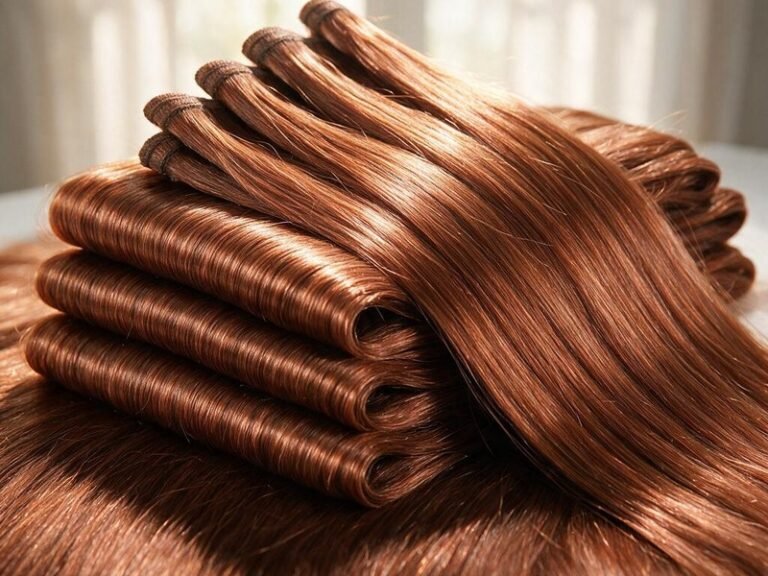
Take weft hair, for example. A weft contains many strands attached along a seam, so consistent hair direction can help the lengths behave more uniformly. The same principle can matter with tape-in hair extensions, where the hair is designed to lie flat and blend with the wearer’s own hair. With K-tip hair extensions, the individual strands are grouped and attached with a keratin tip, making the quality and direction of the hair fibers part of the overall product. In each case, alignment can support a smoother result, but it cannot compensate for poor-quality hair or careless manufacturing.
Another common misconception is that cuticle aligned hair will never tangle, shed, dry out, or change over time. Real human hair does not work that way. Once hair has been removed from the scalp, it no longer receives natural oils from the body. Repeated washing, heat styling, coloring, bleaching, friction, and environmental exposure can all affect its condition. Even well-made extensions need appropriate care. A customer who uses high heat every day and rarely conditions the hair may see a different lifespan than someone who uses lower heat and follows a careful maintenance routine. That difference does not necessarily mean one supplier’s alignment claim was false; it shows why product quality and aftercare have to be considered together.
For buyers, the best approach is to look beyond a single label. Ask whether the hair is human hair, how it was collected, whether the cuticle direction has been preserved, and what processing has been done. If you are comparing several samples, run your hands through the lengths, look closely at the ends, and see how the hair behaves after gentle combing and washing when appropriate. You can also ask the supplier for details about available textures, lengths, colors, and customization. A clear answer is more useful than a vague promise that a product is simply “high quality.”
Cuticle Aligned Hair vs. Remy Hair and Raw Hair
Cuticle aligned hair, Remy hair, and raw hair are often used together in product descriptions, which can make the terminology confusing. The easiest way to understand the difference is to think about what each term is trying to describe. “Cuticle aligned” focuses on the direction of the hair’s cuticles. “Remy” is commonly used for human hair in which the cuticles are kept aligned, although the exact meaning and quality can vary by supplier. “Raw hair” generally focuses more on processing: raw hair is typically described as hair that has had little or no chemical processing. Because these characteristics can overlap, one piece of hair may reasonably be described using more than one of these terms.
This distinction matters when shopping because a label alone does not tell the whole story. For example, raw hair may be cuticle aligned, but the phrase “raw” does not automatically prove that every strand has perfect alignment or that the hair will perform identically to every other raw-hair product. Likewise, Remy hair can be available in different textures and may have undergone certain processing depending on the product. Buyers should therefore ask what the supplier specifically means by each term rather than assuming all products using the same label are identical.
The difference becomes particularly important with raw bulk hair. Loose hair can be used as a starting material for many different products, and the condition of that hair affects what can be done with it later. Some buyers want minimally processed hair because they plan to customize texture or color themselves. Others may want hair that has already been prepared for a specific extension application. Neither approach is automatically right for every customer. The better choice depends on what you are making, how much processing you expect to do, and the consistency you need from one order to the next.
If you are new to bulk hair terminology, it helps to start with the basics before comparing individual suppliers. Our guide, What Is Bulk Hair, explains how bulk human hair differs from finished products such as wefts and other extension formats. From there, you can look at the specific characteristics that matter for your project: hair origin, collection method, cuticle direction, processing, length, texture, color, and available quantities. A professional supplier should be willing to discuss these details rather than relying only on marketing terms. That kind of transparency makes it much easier to compare samples and decide whether a particular hair specification fits your business or personal use.
How to Choose Quality Cuticle Aligned Hair
If you are buying cuticle aligned hair for a salon, hair brand, manufacturing project, or personal use, start with the finished result you need. Think about the extension method, desired length, texture, color, quantity, and how much processing the hair will receive. A salon ordering hair for regular client appointments may have different priorities from a brand developing a private-label collection. Once those requirements are clear, ask suppliers specific questions about the hair itself. How is it collected? How is the cuticle direction preserved? Has the hair been chemically treated? Is it sorted by length and quality? Can you order a sample before committing to a larger quantity? These questions reveal much more than a generic “premium hair” label.
Samples are especially useful. If you are evaluating human hair extensions, examine the hair in your hands rather than judging it only from photographs. Look at the ends, feel the texture through the lengths, and check whether the strands behave consistently. If the supplier offers the same hair in multiple colors or textures, ask whether the processing differs between versions. This matters because coloring and other chemical treatments can change the feel and performance of human hair. If bleaching is part of your plan, discuss that process with the supplier before placing a production order rather than assuming every hair type will respond the same way.
Supplier transparency is another important part of the buying process. Look for a company that can clearly explain its sourcing, quality-control process, product specifications, and order requirements. You can review an About Us page to understand the supplier’s background, and an FAQ page can help answer practical questions about ordering, shipping, and product details. For larger wholesale purchases, it is reasonable to ask for samples, specifications, packaging information, lead times, and the terms that apply to your order. Written details can prevent misunderstandings later, especially when you are purchasing customized hair.
Ultimately, cuticle alignment is valuable because hair direction can influence how strands interact, but it is not a complete definition of quality. The best buying decision comes from looking at the entire product: the condition of the hair, how it was collected, the degree of processing, manufacturing quality, consistency between samples and bulk orders, and the care required after purchase. If a supplier can explain these points clearly and provide a representative sample, you have much better information to work with. That is the practical meaning behind the term: cuticle aligned hair is about preserving the natural direction of the hair fibers, while overall quality depends on everything that happens before, during, and after that alignment is maintained.