Retail Margin Math for Hair Extension Store Owners
If you’ve ever stared at a wholesale invoice at 10pm wondering why your register shows a great sales week but your bank account looks thin, you’re not alone. We talk to dozens of brick-and-mortar and online hair store owners every month in our warehouse, and 9 times out of 10, the gap comes down to skipping the boring, unglamorous retail margin math that keeps the lights on. You don’t need an MBA to get this right — you just need to count the costs most new owners forget to add in.
Your wholesale cost per bundle isn’t the number you think it is
Most new owners pull the per-unit price straight from a wholesale price list and call that their cost of goods sold. That’s the first, and most expensive, math mistake you can make.
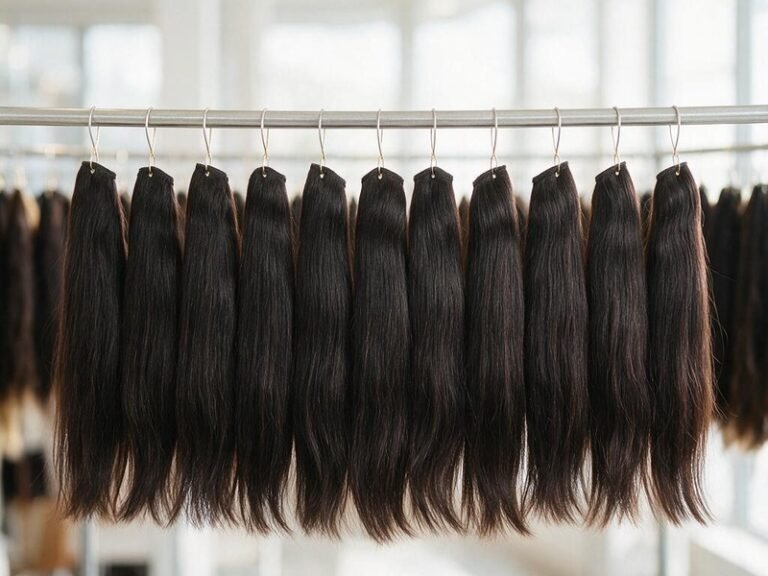
Let’s use a real example from our warehouse: a standard 100g, 18-inch straight bundle of weft hair lists for $28 wholesale. If you only count that $28, you’re missing all the small costs that add up before that bundle is ready to hand to a customer. On a standard 50-bundle MOQ, prorated shipping works out to $3.20 per bundle. Branded hangtags, poly mailers, and tissue paper add another $1.10 per unit. We’ve tracked enough orders to know roughly 12% of stock will sit unsold for 8 months or more — that one random length or shade you thought would be a hit, but never catches on — so that write-off adds another $1.90 per bundle. Then factor in the 5% of units returned for wrong shade matches or minor shipping damage, even when the hair is perfectly good, and that’s another $0.80 per unit to cover processing and restocking.
That $28 bundle? Your real, fully loaded cost to have it ready to sell is $35. Not $28. If you price that bundle at $60 thinking you’re pocketing $32 in profit, you’re actually making $25 before you pay a single business bill.
The 50% margin myth that sinks new stores
You’ve probably heard the old retail rule: keystone your pricing, double your cost, and you’ll hit a healthy 50% margin. That advice isn’t wrong — it just assumes you’re using your real, fully loaded COGS, not the line-item price on a wholesale sheet.
Take that same $28 weft bundle. If you double the listed wholesale price to $56, you’ll think you’re hitting that 50% margin target. But with a real COGS of $35, your actual gross margin is only 37.5%. That might sound fine until you do the rest of the math. For a small online store, fixed costs — payment processing, platform fees, ad spend, the hourly wage you pay yourself to pack orders and answer DMs — eat up 18-22% of every dollar in revenue. For a brick-and-mortar shop, that number jumps to 30-35% once you add rent, utilities, and part-time staff. At 37.5% gross margin, an online store is left with 15-19% profit at best, and a physical store is left with 2-7% — barely enough to cover a broken POS system or slow January sales month.
This is why we see so many owners post six-figure sales months and still struggle to pay themselves. The math looks good on paper until you count all the costs. Higher-turnover, lighter items like tape-in hair extensions can help nudge your average margin up, because their lighter weight cuts per-unit shipping costs, and they sell 30% faster than single long-length bundles, so you have less dead stock to write off. A standard 20-piece tape-in set lists for $42 wholesale, with a fully loaded COGS of $49, and sells for $120 at most independent stores — that’s a 59% gross margin, enough buffer to cover fixed costs and still take home real pay.
Product mix matters more than per-unit markup
You don’t have to mark every single item in your store to the exact same margin percentage. In fact, if you do, you’ll either price yourself out of the market on high-demand, price-shopped items, or leave money on the table on specialty pieces people will pay a premium for.
Here’s the play we see work for 80% of our long-term repeat buyers: price your high-turnover, price-sensitive items — like bulk hair for braiding, basic 14-18 inch straight bundles — at a 45-50% gross margin, so you’re competitive on the items regular clients and local braiders will price-shop across three or four stores. Price your lower-turnover, higher-perceived-value items — like 26+ inch curly bundles, k-tip sets, custom colored pieces — at 65-70% margin, because clients buying those aren’t driving across town to save $10. They’re shopping for a specific look, and they’ll pay for consistent quality they can trust.
Don’t sleep on the tiny, low-cost add-ons either: edge control, loop needles, replacement tape tabs, silk scrunchies. Those items cost you $1-2 per unit and sell for $8-12, with 80%+ margins, and they add up fast when every client grabs one on their way to checkout. When you’re calculating those COGS numbers, don’t forget to add in the cost of retail labels and UPC barcodes if you sell in person or on major marketplaces — it’s a tiny per-unit cost, but skipping it when you run your numbers can throw off your pricing by a dollar or two per item, adding up to hundreds of dollars a year.
We worked with a buyer outside Atlanta a couple years ago who marked every single SKU at 60% margin, no exceptions. Her bulk braiding hair was $3 more per pack than the shop 10 minutes down the road, so local braiders never stopped in. She dropped her bulk hair price to hit a 48% margin, raised her 28-inch curly bundle price by $15 to hit 68% margin, and added a small display of edge control and tools by her register. In three months, her overall average margin was up 7%, and total sales jumped 22% — because braiders came for the competitively priced bulk hair, and left with higher-margin bundles and add-ons every visit.
The hidden costs that eat 10% of your margin before you notice
Most owners remember to count rent, ad spend, and outgoing shipping costs when they run their numbers. But there are three small, recurring costs that nibble away at margins until you’re left with almost no profit, and almost every new owner misses them at first:
- Dead stock: The neon pink 30-inch bundles you ordered for festival season, the 10-inch pixie tape-ins you bought on a gut feeling, the last few packs of a texture you discontinued. Build a 10-15% dead stock buffer into every order’s COGS, instead of pretending every unit will sell at full price.
- Transaction fees: Even in-store, you’re paying 2.5-3% per card transaction, plus the cost of receipt paper, shopping bags, and free sample packs for regulars. Online sellers pay another 2-3% in platform fees on top of standard processing rates.
- Planned discounts: The 10% off for first-time clients, birthday discounts for regulars, end-of-season sales to clear slow stock. If you know you’ll run promotions year-round, build that discount into your regular pricing so you don’t sell at a loss during sales.
These costs don’t look big on any single order, but across a full year, they typically add up to 8-12% of total revenue. We see this hit owners hardest every holiday season, when they overstock on trendy, limited-edition items without building a dead stock buffer into their pricing, then get stuck with piles of unsold inventory in January they have to discount so steeply they erase all their Q4 profit. If you’re mapping out your end-of-year stock plans, our Q4 buying guide walks through a simple formula to order enough stock to meet demand without getting stuck with shelves of product you can’t move.
Quick retail margin math questions we get every week
What’s a good target margin for a small hair extension store?
Honestly, for most independent shops — online or brick and mortar, with 1-3 employees and no big franchise overhead — aim for an average gross margin of 55-60% across all your products. That’s high enough to cover fixed costs, pay yourself a fair wage, and reinvest a little back into new stock or marketing each quarter, but not so high that you price yourself out of your local market. If you’re consistently hitting below 50% average margin, you’ll struggle to cover surprise costs like a website outage, rent hike, or slow post-holiday sales. If you’re consistently hitting above 65% average margin, do a quick check of local competitor pricing — you might be leaving sales on the table by overpricing core, high-turnover items.
Should I switch to cheaper wholesale hair to raise margins?
Tread really carefully here. It’s tempting to jump to the cheapest possible factory to cut your per-unit cost by $5-10 a bundle, but we’ve seen hundreds of owners do this and lose more money than they save. If the hair tangles after two washes, or sheds so badly clients bring half their purchase back for a refund, you’ll spend more time processing returns and repairing bad word-of-mouth than you saved on the cheaper stock. You don’t need luxury top-tier hair for every SKU, but you do need consistent quality that matches your advertised price point.
How often do I need to recalculate my margins?
At minimum, every time you place a new wholesale order. Shipping rates change, packaging costs go up, and sales trends shift, so the numbers you crunched six months ago might not be accurate today. It only takes 15 minutes to add up all your costs for a new shipment, and it will save you from accidentally underpricing stock for months at a time. If you run a big sale, raise your ad spend, or move to a new sales platform, run the numbers again to make sure you’re not accidentally eating into your own profit.
Margin math isn’t glamorous. It doesn’t make for viral social media content, and it’s way less fun than unboxing new texture samples or planning your first local pop-up. But it’s the difference between running an expensive side hustle and running a sustainable store that pays your bills and grows year over year. Next time you’re getting ready to price a new shipment, don’t just glance at the per-unit line on your invoice. Add up every small cost, build in a buffer for the unexpected, and price your stock so you don’t end the month staring at your bank account wondering where all the sales money went. If you have questions about calculating landed costs for a specific order size or texture, our team is always happy to walk you through the numbers before you order, no pushy sales pitch required.
Send Us Your Hair Inquiry
Need bulk pricing, samples, or a private-label quote? Fill in the form and our team will get back to you within one business day.