Human Hair Bundles Deep Wave: How to Choose a Reliable Supplier
The short answer: a reliable deep wave human hair bundle supplier should prove hair origin, texture consistency, cuticle quality, weight, shedding standards, and repeat-order stability before you place a large order. Do not buy from a polished factory photo set alone; order samples, wash them, inspect the wefts, and compare at least two production batches.
Deep wave is one of those textures that can look perfect in a product photo and disappoint after one co-wash. Curl looseness, mixed ends, steam odor, tangling, short filler hair, and inconsistent weft width are common problems for salon owners, braiders, vendors, and resellers.
This guide walks you through the sourcing checks we would use if we were evaluating a new supplier for wholesale human hair bundles in deep wave.
What Are Human Hair Bundles Deep Wave?
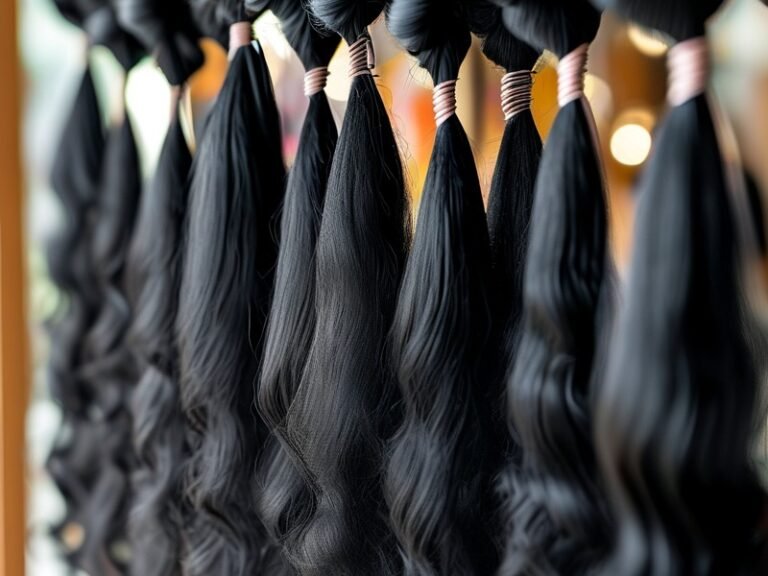
Human hair bundles deep wave are weft-sewn bundles of real human hair with a soft, defined S-shaped curl pattern. A weft is the stitched horizontal track at the top of the bundle that stylists sew or secure during an install, meaning the application of tracks, closures, frontals, or other extension pieces.
Deep wave is not the same as water wave, curly, or loose wave. Deep wave usually has tighter, smoother, more uniform ridges from top to bottom. It looks fuller than body wave, but it is generally less compact and less springy than a tight kinky curly texture.
Buyers should know that many Chinese factories source globally, sort hair, steam-set textures, and sew wefts in-house. The label “human hair” does not automatically mean the hair is virgin, Remy, raw, or cuticle aligned. Those terms need separate verification.
Virgin hair means chemically unprocessed hair, though color and texture can still vary naturally. Remy means the hair roots and tips are kept oriented in the same direction, which helps reduce tangling. Raw hair usually means minimally processed donor hair without texture-altering steam or acid baths, while cuticle aligned means the outer cuticle layer runs in one direction.
How Can You Verify Deep Wave Hair Quality Before Ordering Bulk?
Always sample before committing to a wholesale order. Ask for two or three bundles from the current stock, preferably in 18-inch, 22-inch, and 26-inch lengths. Longer bundles expose weak ends, uneven curl, and density loss faster than one short sample.
First inspect the bundle dry. Run your fingers from top to bottom, then from bottom toward the top with light pressure. Cuticle-aligned hair should feel smoother root-to-tip and slightly resistant when pushed the wrong way. If it feels equally slick in both directions, the cuticles may have been stripped or coated.
Then co-wash the sample with a moisturizing, sulfate-free conditioner. Let it air dry without heavy product. A reliable deep wave pattern should return in a consistent S-curl, not become frizzy, stringy, or straight at the ends. Light steam processing is normal for texture formation, but the pattern should survive repeated washing.
Check the bundle weight. Most standard bundles are around 100 grams, or 3.5 ounces, though some suppliers offer 95-gram or 105-gram versions. Confirm whether the quoted price is per bundle, per kilogram, or per set. A cheaper bundle can simply be 15 to 25 grams lighter.
- Smell: A slight factory scent can fade after washing, but strong chemical, sour, or burned odors are a warning sign.
- Shedding: A few loose hairs from cutting and sewing can be normal; continuous clumps or thin tracks are not.
- Wefting: Look for even stitching, secure turns, minimal gaps, and no thick lumps that create bulky install tracks.
- Ends: Watch for short filler hair, split cottony ends, or bundles that look thick near the weft and thin by mid-shaft.
- Curl return: Compare wet, air-dried, and lightly styled curls after washing. The pattern should remain recognizable.
- Color: Natural black and natural brown can vary by batch. Ask suppliers how they match repeat orders.
- Heat test: A low-heat flat-iron test helps, but remember that steamed textures may loosen temporarily and need water to reset.
What Should B2B Buyers Ask a Deep Wave Bundle Supplier?
Start with direct product questions, not just pricing. Ask whether the hair is 100 percent cuticle aligned human hair, whether it is Remy, whether the curl is steam set, and what percentage of mixed or non-Remy hair, if any, may appear in the grade. A supplier who cannot answer clearly may be trading inventory instead of controlling production.
Ask for exact specifications: grams per bundle, bundle length range, weft width, hair origin, donor mix, processing method, color range, moisture content before weighing, and packaging dimensions. Also ask if the bundles are machine double-wefted, hand-tied, or reinforced. These details matter because they affect price, install comfort, shedding, and shipping cost.
Request batch evidence. That can include current stock videos, close-up weft photos, wet curl photos, length measurement videos, and photos from the actual production run. Catalog images are useful, but they are not proof of stock. A dependable supplier should be willing to show the exact product you will receive.
Discuss quality control before payment. Ask how many workers inspect each bundle, whether they check curl direction and length, whether returned hair is accepted after testing, and what happens if a batch sheds, smells, or differs from the approved sample. Clear claims handling matters more than a promise that “nothing goes wrong.”
Also ask about custom packaging and labeling. Many resellers need hangtags, bundle wraps, plain boxes, private labels, satin bags, or custom logos. Find out the MOQ, meaning minimum order quantity, for customization, the packaging lead time, and whether branded packaging delays reorders.
Are Virgin, Remy, Raw, and Cuticle Aligned Deep Wave Bundles Different?
Yes, and the differences directly affect cost. Virgin deep wave hair is human hair that has not been dyed, permed, relaxeded, or otherwise chemically processed. It can still be washed, sanitized, sorted, and steam shaped into a deep wave pattern. Because supply is limited and sorting is labor-intensive, true virgin hair usually costs more.
Remy deep wave bundles keep hairs aligned root to tip. Remy can be virgin or processed, so “Remy” alone does not prove the hair has never been colored. The main benefit is better tangling resistance when the cuticles are properly kept in one direction.
Raw hair is usually the least processed category and often comes with more natural texture variation. Raw hair can be excellent, but buyers should not expect every batch to look identical. If a supplier promises unlimited raw deep wave in every length with perfectly identical curls, ask more questions; natural donor supply does not behave like a fully manufactured product.
Cuticle-aligned hair focuses on the direction and condition of the cuticle layer. This is one of the most useful quality claims for deep wave because curly textures tangle more easily when cuticles run opposite ways. Still, the phrase can be misused, so verify it by feel, washing, combing, and repeat-batch consistency.
Lower-cost deep wave bundles may use cuticle-stripped hair with silicone coating. They can feel soft when new, but after washing the coating may wash away and the hair becomes dry, matted, or hard to manage. This is why a cheap initial sample is not enough unless it has been washed and inspected.
How Do You Compare Wholesale Pricing Without Getting Trapped?
Compare price by finished gram, hair grade, length, and consistency—not by bundle count alone. A 100-gram bundle at one price is not the same as an 80-gram bundle at a slightly lower price. Longer lengths also carry a steep cost increase because long donor hair is harder to source and produces more waste during sorting.
Ask whether quotes include packaging, labels, shipping, taxes, and customs documents. A factory price can look attractive until you add private labeling, export handling, dimensional shipping, and replacement costs for bad bundles. For repeat sales, calculate your true landed cost per sellable bundle.
Be cautious with unusually low quotes for 100-gram deep wave in lengths over 24 inches. Deep wave naturally measures shorter when pulled straight, and some suppliers list curly length based on the natural curly state rather than fully stretched length. Confirm the measurement method before comparing offers.
MOQs vary by supplier and customization level. Stock bundles may have a low MOQ, sometimes 10 to 50 pieces depending on the vendor, while custom labels or special packaging often require 100 pieces or more. Private-label colors, custom tags, and bespoke bundle wraps can add 7 to 20 days on top of normal production.
Lead times should be realistic. Stock deep wave bundles may ship in 2 to 7 business days, while production orders can take 7 to 20 business days depending on length, quantity, color, and packaging. Peak sale seasons and holiday closures can add time, so confirm capacity before running client preorders.
Which Deep Wave Details Matter Most for Salon and Resale Success?
Texture consistency is the biggest factor for repeat customers. Your clients may buy 20-inch deep wave one month and 24-inch deep wave three months later. If the second batch looks like water wave or has looser ends, they may blame your business even if the factory changed the hair.
Density and fullness also matter. Density describes how much hair is packed into a closure, frontal, wig, or bundle setup. Bundles do not use density labels the same way wigs do, but clients still describe them as thick or thin. For a typical sew-in, many stylists use three bundles for 12 to 18 inches, three to four bundles for 20 to 26 inches, and four or more for lengths beyond that, depending on desired fullness and head size.
A closure is a small lace or silk piece used to close a style, usually covering the crown area. A frontal is a wider ear-to-ear piece used to recreate the hairline. If your supplier sells matching deep wave closures and frontals, verify that curl pattern, hair color, sheen, and knot quality match the bundles. Mismatched pieces are a common complaint.
Bulk hair is loose hair without a weft, often used for braiding or custom wig work. Tape-in extensions are sandwich-style adhesive wefts, while k-tip extensions use individual keratin bonds. If your business expands beyond bundles, choose a supplier that can match the same deep wave donor quality across products instead of buying unrelated hair from multiple factories.
Packaging should protect curl pattern and reduce friction. Bundles should be completely dry before sealing, wrapped so the wefts do not rub, and labeled with length and texture. Moisture trapped in plastic can create a musty smell during long shipping, especially in humid conditions.
What Red Flags Should You Avoid in a Hair Supplier?
A major red flag is a supplier who refuses sample orders, current stock videos, or batch-specific photos. If every answer is “same as picture” and they cannot explain hair origin, grams, wefting, or processing, you are probably dealing with a reseller with limited quality control.
Watch for grade inflation. Vague labels such as “10A,” “12A,” or “luxury grade” do not mean much without a written specification. Suppliers use grade systems differently, so define the actual product: 100 grams, human hair, Remy, cuticle aligned, double weft, steam-set deep wave, natural color, minimal shedding, and matched pattern.
Avoid suppliers who promise that curly hair never sheds, never tangles, or stays exactly the same forever. Human hair, especially textured hair, needs maintenance. Sewing through wefts, cutting tracks improperly, heavy product buildup, rough combing, and sleeping without protection can all affect performance.
Poor communication is another warning. B2B sourcing needs order confirmations, packing lists, length checks, damage policies, and production updates. If a sales representative disappears before payment is protected, they will likely be harder to reach after a problem shipment arrives.
Finally, be wary of pressure to place a massive first order. A reliable supplier should help you test the market with samples, stock colors, standard packaging, and a modest production order. Once your customers confirm the texture and longevity, you can increase volume and add private labeling with less risk.
How Should You Test Deep Wave Samples for Repeat Orders?
Create a simple sample scorecard and use it for every supplier. Score curl pattern, softness, wet curl return, shedding, weft security, end fullness, smell, color, true length, and packaging. Assign each factor a number so you are not choosing based only on first touch.
Wash the sample twice before judging it. Use lukewarm water, a gentle sulfate-free shampoo or moisturizing co-wash, and a small amount of leave-in conditioner. Detangle from ends upward with a wide-tooth comb or fingers while the hair is wet and conditioned. Rinse thoroughly and let it air dry on a rack.
Measure the hair after gently pulling it straight, then record the weight before washing and after it is fully dry. Surface water can temporarily add weight, so never compare dry bundle value with wet hair. Compare the ends under bright light; dry, split, or overly thin ends are hard to hide after styling.
If possible, have a stylist install or sew a small section. They can feel whether the weft lies flat, whether it sheds when pierced, and whether the track is too thick or stiff. Client-facing feedback is useful, but technical feedback from someone who works with wefts can save you from a bad inventory buy.
Keep the approved sample and label it with supplier name, order date, length, grade, and batch. When your reorder arrives, compare it side by side with the approved hair. This gives you a factual reference if the curl pattern, color, or weft quality changes.
Frequently Asked Questions
How many deep wave bundles do clients usually need?
Most clients need three bundles for a full sew-in at medium lengths, with longer or fuller styles often needing four. If a closure or frontal is used, the bundle count may be slightly lower because the closure piece covers part of the head. Your client’s head size, desired fullness, cut method, and bundle length should guide the recommendation.
Can deep wave human hair bundles be straightened?
Yes, most quality deep wave bundles can be flat-ironed on a low to medium heat setting after proper heat protection, but frequent high heat can dry the ends and loosen steam-set texture over time. The curl usually returns best after washing or wetting, though results depend on how the hair was processed. Tell clients to deep condition regularly, sleep with a satin bonnet or scarf, and avoid aggressive brushing while dry.
Choosing a reliable deep wave supplier is a process: verify specifications, test samples, compare batches, and ask for clear policies before scaling your orders. If you want help planning a wholesale order, tell us your target lengths, bundle grams, MOQ, packaging needs, and expected reorder schedule.
If you want the full background before you order, our guide on Human Hair Bundles Water Wave: How to Choose a Reliable Supplier walks through it in plain terms.
Send Us Your Hair Inquiry
Need bulk pricing, samples, or a private-label quote? Fill in the form and our team will get back to you within one business day.