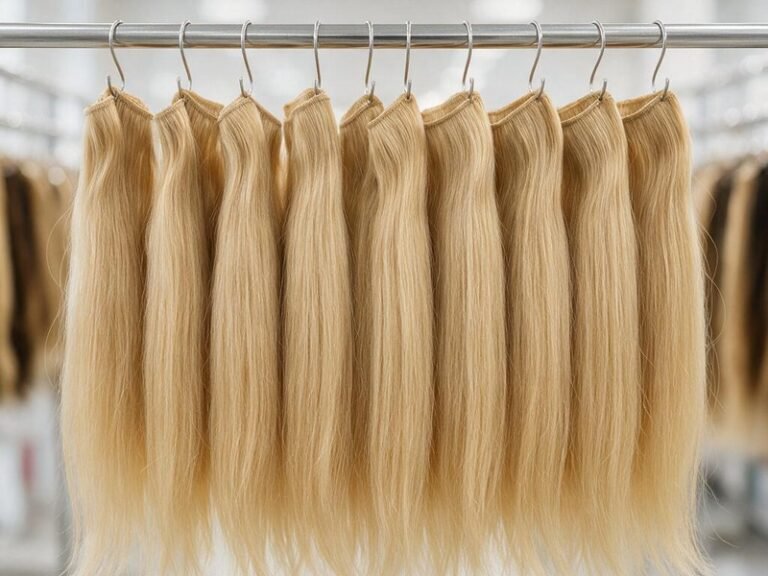
How to Read a Hair Extension Price List From China
If you’ve ever gotten a hair extension price list from China and stared at it like it’s written in code, you’re not alone. We see new salon owners and resellers miss fine print every single week, leading to surprise charges, wrong hair grades, or shipments that don’t match what they thought they ordered. Learning to parse that list correctly doesn’t just save you money—it keeps your regular clients happy and your margins where they need to be.
The first column most buyers skip entirely
Almost every new buyer zooms straight to the inch length and the per-bundle price, then starts comparing numbers across suppliers without glancing at the weight column. That’s the easiest way to get tricked into thinking you got a steal. A lot of factories tweak pack weights to hit price points that look good in Instagram ads. We’ve seen lists advertise 20” virgin straight bundles for $7 less than competitors, only to note in 8pt font at the top of the column that each bundle is 80g, not the standard 100g most US buyers expect.
Do the quick math: that $28 “cheap” bundle works out to $0.35 per gram, while the $32 100g bundle is $0.32 per gram. The more expensive sticker is the better value. This applies to every product type, too. Some tape-in packs are 50g total, others 60g, some k-tip packs are 100 strands vs 125 strands for the same listed price. You can’t do a fair comparison if you don’t lock in weight first.
Grade labels don’t mean what you think they do
Let’s get this out of the way first: there is no universal, industry-wide standard for 8A, 10A, 12A hair. None. Every factory sets its own grade tiers based on internal quality checks, so a “12A” bundle from one supplier might be the exact same hair another factory labels “9A”, or even worse, chemically processed non-remy hair that will matte after two washes.
If you see a price list advertising 30” raw curly bundles for $25, run. That price point is impossible for intact, cuticle-aligned hair that will last 6+ months of wear. For reference, unprocessed 22” wavy virgin hair usually lands in the $29-$42 per 100g bundle range for wholesale orders. Anything under that range almost always has stripped cuticles, mixed in short filler hair, or a small percentage of synthetic fibers to bulk up the weight. Anything well over that range means you’re paying a middleman markup, not getting a better product. Mismatched grade expectations are one of the most common issues we hear about from buyers who switch suppliers, which we cover more in our post on avoiding wholesale hair buying mistakes.
Hidden fees that turn a “great price” into a budget buster
The biggest number on the price list is almost never the final number you pay. Most factories list base EXW pricing, meaning you cover every cost from the factory door to your store, and smaller trading companies often tuck extra fees into footnotes most people skip until invoice time.
The fees that catch most people off guard? They’re almost always the same ones:
- Per-unit upcharges for small orders under the MOQ tier, usually 20-40% higher than the advertised bulk price.
- Payment processing fees, ranging from 3% for PayPal to 8% from suppliers who hide the cost until invoicing.
- US customs duties and clearance fees, averaging 8-9% of total declared value, plus occasional carrier brokerage fees.
If a line on the price list doesn’t explicitly say a cost is included, assume it’s extra. Don’t guess. We always tell buyers to send a quick follow-up asking for an all-in total for their exact order size before sending payment, and if a supplier hedges or refuses to give that number, walk away. If you’re not sure what baseline details a fair quote should include, our FAQ page covers the non-negotiables to ask for before you order.
Texture and length pricing isn’t one-size-fits-all
A lot of new buyers see the base price for straight hair and assume that rate applies across every texture and length. It never does. Curly, kinky, and deep wave textures usually cost 10-18% more than straight hair of the same grade, because steam-setting curls takes extra labor and creates more waste when sorting cuticle-aligned hair.
Length premiums get even steeper past 24 inches. Long, intact virgin hair over 26 inches is rare, so prices jump 60-70% between 22” and 30” bundles, instead of the $2-$3 per inch increase for shorter lengths. If a list shows the same rate for straight, deep curly, and 30” hair, that’s a red flag. The supplier is either mixing in 4-6 inches of short filler hair near the weft to hit weight targets, or selling heavily processed hair that will fray fast. If you’re stocking up for braiding season, bulk hair for braiding is priced differently than wefted hair, since it skips the weft sewing step, so don’t use weft prices to estimate bulk costs.
The fine print on “free” perks
Most price lists advertise free services to sweeten the deal, but those offers rarely mean what you think. “Free custom packaging” is almost always a clear polybag with your logo sticker, not custom printed boxes or satin dust bags. Actual upgraded branded packaging runs $0.50-$2 per unit. “Free quality checks” just means a worker glances for obvious weft gaps before packing, not a strand-by-strand test for cuticle alignment or split ends.
Even shipping times can be misleading: “3-5 day DHL delivery” refers to transit time after production finishes, not door-to-door time from order placement. Custom colored hair or rare textures can take 7-12 business days to produce before shipping, and we’ve seen buyers miss big pop-up events because they didn’t account for that lag. If you’re mapping out your client pricing after stock arrives, our guide on pricing salon hair services can help you build those extra costs and lead times into your rates.
Quick questions about reading a hair extension price list
Is the lowest price per gram always the best deal?
Not always. A $0.03-$0.05 higher per-gram price often means the supplier trimmed excess short return hair, runs proper cuticle alignment checks, and will replace defective bundles without a fight. The cheapest per-gram hair we ever tested (sent by a buyer wanting a second opinion) had 20% synthetic heat-resistant fiber mixed in, which would have destroyed that buyer’s reputation if sold to regulars. Save rock-bottom hair for practice mannequins, not paying clients.
Do I really need to order a sample first?
Yes, every time, even if the price list looks perfect. A price list is just words on a screen until you can hold the hair, weigh it on your own scale, wash it a couple times to test for matting, and check that the weft doesn’t shed excessively. A $50 sample order (with shipping) is way cheaper than getting stuck with $2,000 worth of hair you can’t use. If you’re building your first stock order, our line of hand-tied and machine wefts, k-tips, and tape-ins list weights, texture premiums, and lead times right on each product page so you don’t hunt for fine print.
How do I compare two price lists fairly?
Start by stripping out marketing language and grade labels, then line up every hard spec side by side: weight per unit, hair type, texture upcharges, all fees, shipping timelines, and return policies. If one supplier’s price is 20% lower but their defect return window is 3 days (vs 14 days with a competitor), that lower price comes with major risk you’ll eat the cost of bad stock.
At the end of the day, a Chinese hair extension price list isn’t designed to trick you. It’s written by factory teams who work with hair every day, and they often assume every buyer already knows the industry lingo, standard fees, and spec differences that take new vendors a few orders to learn. You don’t need decades of experience to get a fair deal. You just need to slow down, read the fine print columns, and never be afraid to ask for clarification on a line item that doesn’t add up. If you’re tired of hunting for hidden fees on confusing price sheets, you can browse our transparent wholesale pricing any time to build your next order.
Send Us Your Hair Inquiry
Need bulk pricing, samples, or a private-label quote? Fill in the form and our team will get back to you within one business day.