Deep Wave Bundles Human Hair: A B2B Buying Guide for Hair Businesses
Deep wave bundles human hair can be a strong repeat-order product if you buy the right texture, weight, and grade for your customer base. The short version for B2B buyers: don’t shop by “grade” labels alone—verify hair origin, weft quality, curl return, shedding limits, MOQ, and factory consistency before placing a wholesale order.
This guide is written for salon owners, braiders, beauty-supply buyers, online vendors, and resellers ordering from China-based suppliers. Deep wave is a tighter, defined S-pattern that looks fuller than body wave, but it also needs clearer customer education because buyers often confuse it with water wave, curly, and loose deep wave.
What Are Deep Wave Bundles Human Hair, and Who Buys Them?
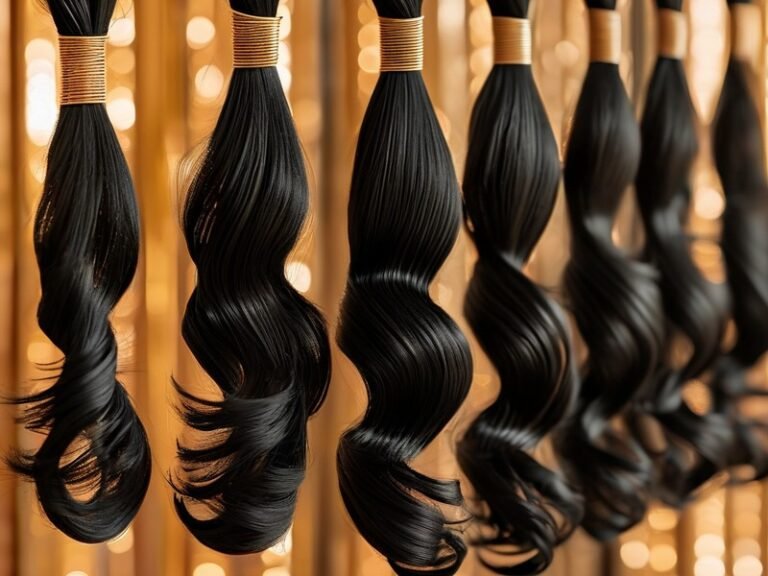
Deep wave bundles are sewn wefts of human hair with a repeated deep S-curl from the weft down toward the ends. A weft is the stitched horizontal track that stylists sew or clip into an install; an install is the full application method, such as a sew-in, quick weave, wig, or customized unit.
Deep wave sits between looser body-wave patterns and tighter curly textures. It usually has more volume and a more visible curl pattern than loose wave or natural wave, but not the compact spring of kinky curly or afro curly. That makes it popular with customers who want defined curls without high-shrinkage styling.
Typical B2B buyers stock it for sew-ins, wig making, salon custom units, and online bundle deals. The customer profile is broad: first-time extension wearers, vacation clients, brides, college students, and wig makers all buy deep wave, but they may expect very different quality levels and price points.
Your product line should reflect that split. A salon may need fewer bundles but cleaner cuticles and dependable coloring results. A beauty-supply store may need competitive entry-level inventory with uniform packaging and steady stock. A wig maker may care most about weft flatness, bundle weight, and how the curls behave after washing.
Virgin, Remy, Raw, or Cuticle Aligned: Which Hair Should You Stock?
These terms get mixed together in wholesale listings, and suppliers sometimes use them as marketing words instead of quality controls. Ask for a clear definition in writing, plus photos or videos of the exact inventory you will receive.
Virgin hair means human hair that has not been chemically processed, colored, permed, or steamed beyond texture treatment. In practice, many “virgin” deep wave textures are steam-processed to create the pattern, so ask whether the supplier uses steam, chemical texture setting, or both.
Remy hair means the hair roots and tips are kept oriented in the same direction. Remy does not automatically mean unprocessed or premium quality, but properly oriented hair usually tangles less than non-Remy hair where cuticles run in opposite directions.
Raw hair is generally unprocessed donor hair with minimal steam or chemical treatment. Raw deep wave can vary more by donor, batch, and country of origin. It often costs more, has less uniform curls, and may not look identical from bundle to bundle. That natural variation is normal, but it can cause complaints if your product photos suggest a perfect factory curl.
Cuticle aligned hair means the outer cuticle layer runs in one direction. For B2B buyers, this is one of the most useful quality claims to test because it directly affects tangling, matting, and longevity. Ask whether the hair is fully cuticle intact, lightly acid-treated, or cuticle-stripped and silicone-coated. The last option may feel soft at first but can become dry or tangled after washes.
How Do Deep Wave, Water Wave, Loose Deep Wave, and Curly Hair Compare?
Texture confusion causes a lot of avoidable returns. If your website or salon menu says “deep wave” but the customer expected a wet-looking water wave, the order can feel wrong even if the hair itself is good.
- Deep wave: defined S-shaped waves with medium-to-full volume and a consistent spiral-like flow.
- Water wave: softer, wet-look curls with more irregular ringlets and more shrinkage around the ends.
- Loose deep wave: a wider, softer version of deep wave with less density and less curl tightness.
- Curly: tighter spring curls, usually more compact and more likely to shrink when dry.
- Kinky curly: the tightest natural-textured pattern, with more shrinkage and specific detangling needs.
For wholesale inventory, use exact texture names and show the hair dry, wet, brushed, and after washing. One texture video can prevent more returns than a long product description. If you sell matching closures or frontals, test them from the same batch because a closure is a small lace piece used to close a sew-in or wig, while a frontal is a wider ear-to-ear lace piece that creates a new hairline.
Keep in mind that curly hair naturally looks shorter when the pattern contracts. A 24-inch deep wave bundle will not visually hang like a 24-inch straight bundle. Give customers stretched length and shrinkage guidance before purchase, especially for 22-inch and longer styles.
What Bundle Length, Weight, and Density Should Your Hair Business Order?
Most standard single bundles weigh about 95 to 100 grams, or 3.3 to 3.5 ounces. Some premium markets advertise 3.5 ounces or 100 grams per bundle, while promotional bundles may be 90 to 95 grams. Always compare price per gram, not just price per bundle.
A typical sew-in often needs 3 to 4 bundles depending on length, desired fullness, and whether a closure or frontal is used. Shorter lengths from 10 to 14 inches may need 2 to 3 bundles. Lengths from 16 to 22 inches commonly need 3 to 4 bundles. Long installs at 24 to 30 inches may need 4 or more bundles because longer bundles usually have less hair at the ends even when the top weight is correct.
Density means how much hair is packed into a wig, closure, frontal, or finished style. For bundles, customers often use the word loosely to mean fullness. For wigs, 130% to 150% density is common for a natural everyday look, 180% is fuller, and 200% or higher creates a very thick style. Do not confuse wig density with bundle weight; they are measured differently.
For inventory, start with the most sellable lengths: 16, 18, 20, 22, and 24 inches. Add 10 to 14 inches for bob wigs and short sew-ins, and 26 to 30 inches only if your audience regularly buys long hair. Deep wave sells well in natural black, usually a 1B shade, but colored options like honey brown, chestnut, and highlighted piano colors can work if your supplier can lift the hair safely.
What Quality Checks Matter Most for Wholesale Deep Wave Bundles?
A good B2B supplier should let you inspect sample hair before a bulk order. Bulk hair is loose hair without a weft, often used for braiding or custom wig work, but most bundle buyers are checking machine-wefted or hand-tied wefted hair. Your sample should be tested the same way your customers will use it.
First, inspect the weft. It should be tight, evenly stitched, and free of skipped stitches, loose threads, glue clumps, or thick ridges. Machine wefts are durable and common for sew-ins, while hand-tied wefts are thinner and flatter but usually cost more and may require gentler cutting. Pull lightly along the weft to check for obvious shedding, but a few loose hairs in a new bundle is normal; continuous hair loss after shaking or combing is not.
Second, check curl return after washing. Condition the bundle, let it air dry, and see whether the pattern comes back evenly. Good deep wave should retain a recognizable pattern without heavy product, though some finger styling may be needed. Be suspicious if the first wash loosens the curl dramatically, produces a strong chemical smell, or leaves the ends frizzy and straighter than the top.
Third, test tangling and coloring behavior. Run your fingers through the hair when dry and wet, then comb from ends upward with a wide-tooth comb. If you plan to sell hair for colorists, order an extra sample for a strand test using a gentle lift. Lower-quality hair may survive basic rinses but become dry, gummy, or tangled after bleaching.
Finally, check batch consistency. Compare at least three bundles from one order for curl size, length, color, luster, and weight. Deep wave can vary naturally, especially raw hair, but wholesale customers still need enough consistency to create matching installs and wigs.
How to Choose a China-Based Human Hair Supplier Without Overordering
Start with a sample order, not a container load. A reliable supplier should answer specific questions about origin, processing, bundle weight, weft type, stock status, lead time, packaging, labeling, and quality issue handling. If the sales representative only repeats “10A grade” or “100% human hair,” keep looking.
Grade numbers such as 8A, 10A, and 12A are not universal industry standards. One factory’s 10A can be another factory’s 7A because the labels are often set by sellers. Use grades as a supplier’s internal product tier, not proof of quality. Your real comparison should be sample performance, hair structure, return rate, and long-term consistency.
Ask practical MOQ questions. MOQ means minimum order quantity, and it can vary by length, texture, color, and customization. Stock deep wave bundles may have a low MOQ, such as 1 to 10 pieces, while custom labels, colored hair, special packaging, or matching closures may require larger minimums. Standard stock orders may ship in 2 to 7 business days, while custom production can take 10 to 25 days or longer during peak seasons.
Expect honest trade-offs. Raw hair is more expensive and less uniform. Steam-processed virgin hair gives a more consistent curl but is not completely untouched. Longer lengths cost more because long healthy donor hair is limited. Cheaper bundles may use shorter strands near the tips, mixed origins, heavier silicone, or lighter bundle weights.
Before scaling, agree on what counts as a defect. Shedding a few hairs, natural color variation, curl looseness after improper combing, and customer shrinkage expectations are not always factory defects. Uneven wefts, bad smells after washing, major pattern loss, wrong lengths, mold, insect damage, synthetic mixing, or batch mismatch should be documented with photos and videos immediately.
What Are Common Mistakes When Buying and Selling Deep Wave?
The biggest mistake is treating all deep wave bundles human hair as the same product. A $29 promotional bundle and a premium raw bundle may both say “100% human hair deep wave,” but they can have different donor sources, processing, weight, longevity, and target customers. Define whether your brand is budget-friendly, salon-grade, raw-hair premium, or wig-maker focused.
Another mistake is weak product education. Deep wave should not be brushed aggressively while dry because that creates frizz and expands the curl pattern. Customers should detangle with conditioner in the shower, use a wide-tooth comb or fingers, scrunch lightly, and air dry. They should sleep with a satin bonnet or scarf and avoid heavy oils that weigh the curls down.
Sellers also get into trouble by promising exact curl matching across closures, frontals, and bundles. Lace pieces are often made separately, so matching should be tested by batch, not assumed from a product name. If you build wig kits, order bundle-and-closure sets together and ask the supplier to match curl, luster, and color before shipment.
Do not overstock rare lengths or bright colors early. Deep wave inventory moves best in natural black and common lengths. Once you know your repeat customers, add colored bundles, HD lace closures, raw curly options, custom packaging, and longer lengths based on actual orders.
Frequently Asked Questions
Is deep wave good for customers with natural hair?
Yes, deep wave can blend well with natural textures, especially when the leave-out, closure, or frontal is styled to match. Your customer should understand that the pattern may still need water, light gel, or finger-rolling to blend with her own hair. For highly textured natural hair, kinky curly or coily textures may be a closer match than standard deep wave.
How many deep wave bundles should a customer buy?
Most customers need 3 to 4 bundles for a full sew-in, with longer or fuller styles often needing 4 or more. Two bundles can work for a short partial style, and a closure or frontal reduces some of the coverage needed across the top. Always recommend by head size, length, desired fullness, and whether the finished look is a sew-in or wig.
Can deep wave bundles be colored or bleached?
High-quality virgin or cuticle aligned human hair can usually be colored, but results depend on how the hair was processed. Always test a small sample first, lift slowly, and use a professional colorist for platinum or pastel shades. Lower-grade or heavily processed hair may become dry, tangled, or weaker after bleaching.
How long should wholesale deep wave bundles last?
With proper care, better virgin or cuticle aligned bundles can last through multiple installs, often around 1 to 2 years, while budget bundles may last several months. Those ranges vary based on nightly protection, washing habits, heat use, coloring, cutting the weft, and how the stylist installs the hair. Give customers realistic care instructions instead of promising a fixed lifespan.
If you are ready to stock deep wave bundles human hair, send us your target length range, preferred hair type, monthly quantity, and whether you need matching closures or frontals. We can help you compare sample options and build a wholesale order that fits your salon, wig line, or resale business without buying more inventory than you can move.
If you want the full background before you order, our guide on Deep Wave Bundles: A B2B Buying Guide for Hair Businesses walks through it in plain terms.
Send Us Your Hair Inquiry
Need bulk pricing, samples, or a private-label quote? Fill in the form and our team will get back to you within one business day.