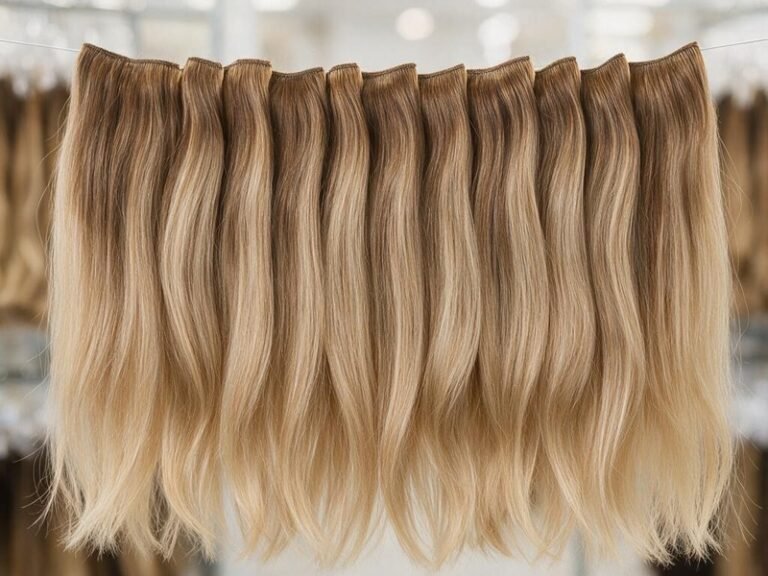
What Is Remy Human Hair?
If you’ve ever ordered hair labeled “100% Remy human hair” only to have it matte and tangle after two washes, you’re not alone. We see this every week from new salon owners and resellers who got burned by suppliers slapping the Remy label on cheap, processed stock to mark up prices 30% or more. This isn’t a textbook definition — it’s what we’ve learned over 12 years sorting bundles in our warehouse, calling out factory shortcuts, and helping buyers stop wasting money on hair that falls apart fast.
The actual definition of Remy human hair (not the marketing version)
At its core, Remy human hair is human hair where every strand’s cuticle is kept fully intact and aligned in the same direction, root to tip. Think of cuticles like the shingles on a roof: if they all lay the same way, water runs off smoothly, nothing catches, and the surface stays even. If they’re flipped every which way, they rub against each other, catch, and create tangles no amount of conditioner can fix.
That aligned cuticle is the entire reason tangle-free hair extensions actually stay smooth long term, not because of some fancy coating or special processing trick. Most people assume Remy is a grade of quality, or a signal that hair is unprocessed, but that’s not right. It’s a description of how the hair is collected and sorted, plain and simple.
How real Remy is processed (and where factories cut corners)
Proper Remy collection starts the second hair is cut from a donor. The collector ties the ponytail tight at the root end before cutting, so no strands flip end over end. From there, the hair goes to a sorting floor where workers go through each bundle by hand, pulling out stray misaligned strands, removing short bits, and double-checking direction before any washing or coloring happens. It’s tedious, slow work.
After sorting, the hair gets a gentle pH-balanced wash, a light processing step if it’s being dyed to standard colors, and a final conditioning treatment to lock cuticles closed. That sorting process adds roughly 2-3 hours of labor per kilogram of hair, which translates to about $15-$25 extra per 100g bundle at wholesale, depending on length.
Here’s the corner cut we see more than any other: factories skip the aligned sorting entirely. They take mixed hair from salon sweepings, loose donation piles where direction was never tracked, or even lower-quality waste hair, strip every last cuticle off with a harsh acid bath, then dip the whole batch in a 2-3% silicone solution to make it feel slippery and soft to the touch. They sew it into wefts, bag it, slap a “100% Premium Remy” sticker on the package, and sell it for 40% less than the real thing. That silicone coating washes out completely in 3-5 shampoos, leaving dry, rough hair that tangles into matted clumps if you so much as look at it wrong.
Remy vs non-Remy: the real tradeoffs, not the sales pitch
We’re not here to tell you non-Remy hair is useless. It has a place, as long as you know exactly what you’re buying and are honest with your clients about what to expect. We break down the actual differences we see day to day in the warehouse:
- Real cuticle-aligned Remy: Lasts 6-12 months with proper at-home care, tangles minimally even after repeated washes, holds curls and heat styling well, can be bleached 2-3 levels without extreme breakage, and costs 30-50% more wholesale than non-Remy. It’s not indestructible — clients who sleep without a bonnet, douse strands in heavy grease, or use 450-degree heat daily will still see dry ends — but it’s resilient enough to stand up to regular wear.
- Non-Remy (often sold as fake Remy): Lasts 4-8 weeks max before matting, feels incredibly soft the first 1-3 washes until the silicone coating wears off, turns brittle if bleached more than one level, and costs 30-50% less than real Remy. It works fine for one-time event installs where the client will take the hair out after a weekend, but it will tank your reviews if you sell it as a long-wear option.
We carry real aligned cuticle Remy across all our lines, from bulk hair for braiding to pre-bonded styles, so buyers can pick the construction that fits their client base without guessing about quality.
The most common fake Remy red flags we spot in the warehouse
You don’t need a lab to test if Remy is real. There are three quick checks we do on every incoming batch, and you can do them too with sample orders. First, run your fingers up a strand from tip to root, against the natural fall of the hair. Real Remy will have a slight, almost unnoticeable drag — like running your hand along a cat’s fur from tail to head. If it feels perfectly smooth both ways, the cuticles are gone, and you’re touching silicone-coated non-Remy. Second, check the price. If a supplier sells 20-inch Remy bundles for under $25 wholesale, walk away. Raw material costs for real 20-inch Remy land around $22 per bundle before processing, labor, and shipping, so there is zero margin to sell real Remy that cheap without cutting corners. Third, do a gentle shed test. A little initial shedding is normal — 5-10 strands when you run a wide-tooth comb through a dry bundle right out of the bag is nothing to worry about. If you’re pulling clumps out on the first comb, you’ve got misaligned strands catching on each other.
If you’re sourcing for sew-in installs, our weft hair goes through that direction check twice before bagging, so you don’t end up with a random matted batch halfway through a client’s install.
Quick answers to the questions we get every week
Is Remy hair the same as virgin hair?
No, that’s one of the most common mix-ups from new buyers. Virgin hair is hair that’s never been chemically treated — no dye, no perm, no relaxer, ever. Remy hair can be virgin, but it can also be gently dyed to popular off-the-shelf shades (1B, #2, #4, even blonde tones) as long as the cuticles stay intact and aligned. A lot of great quality Remy is pre-dyed to match common client color requests, and that doesn’t make it fake. If you’re looking for Remy that can lift all the way to pale blonde without turning to mush, we break down what to look for in our guide to bleaching Chinese human hair, since not all Remy is processed to handle high lift.
Can Remy hair be synthetic?
Nope. Full stop. If you see “synthetic Remy” for sale, that’s a straight-up marketing scam. Remy refers exclusively to cuticle alignment in real human hair. Synthetic fibers are extruded plastic with no cuticles, so the term is completely meaningless there.
Do I need to buy Remy for every client?
Not necessarily. If you’re doing a one-time prom or wedding install for a client who will take the hair out after the event, non-Remy can work as long as you’re upfront about its lifespan and short-term care needs. But if you’re selling retail, or doing installs clients expect to wear for 2+ months, skipping real Remy will cost you more in refunds, redos, and bad reviews than you save on upfront wholesale cost. For semi-permanent installs like tape in hair, we never recommend cutting corners on Remy, because those sit close to the scalp and tangling there is far more noticeable (and uncomfortable) for clients.
Let’s be honest, the hair industry is full of confusing jargon and misleading labels, mostly designed to get you to pay more for lower quality product. You don’t need to memorize a million grading systems or fancy terms to order good stock — you just need to work with suppliers who are upfront about cuticle alignment, processing methods, and the actual lifespan of the hair they sell. If you’re ready to test real Remy for your clients, you can browse our full line, or reach out directly with questions about custom orders, color matching, or wholesale pricing. We don’t do the silicone dip trick, we don’t mislabel non-Remy, and we’ll always tell you exactly what you’re getting before you place an order.
Send Us Your Hair Inquiry
Need bulk pricing, samples, or a private-label quote? Fill in the form and our team will get back to you within one business day.