Private Label Hair: Wholesale Sourcing Mistakes to Avoid
Private label hair means buying wholesale human hair extensions and selling them under your own brand, usually with custom tags or packaging. Most costly mistakes start before the logo is printed: shopping from photos, ignoring bundle weight, and trusting grade letters no one regulates. Here’s what we see in the warehouse and what to confirm before your first bulk order.
What are you actually buying: virgin, Remy, or processed?
Grade labels like 10A and 12A aren’t regulated, so two factories can use the same name for different hair.
Virgin hair is unprocessed human hair; Remy means cuticles face one direction, though it may still be steamed for texture.
Cuticle aligned means the scales run root to tip one way, preventing matting after washing.
If your label promises raw virgin hair but you sell steamed or coated bundles, returns come fast.
Choose the hair type your customers can afford and get that spec in writing, not a grade letter.
Why order samples before a bulk hair order?
We see buyers order 200 pieces from five photos and a price list.
Runs differ in donor mix, texture, and length pulling, so one pretty sample won’t prove the bulk matches.
Sample two or three vendors, wash and flat-iron the hair, and check wefts for shedding.
A $40 sample beats explaining thin, tangling hair to 80 clients.
If a supplier refuses samples or pushes blind ordering, walk away.
How many grams should a private label bundle weigh?
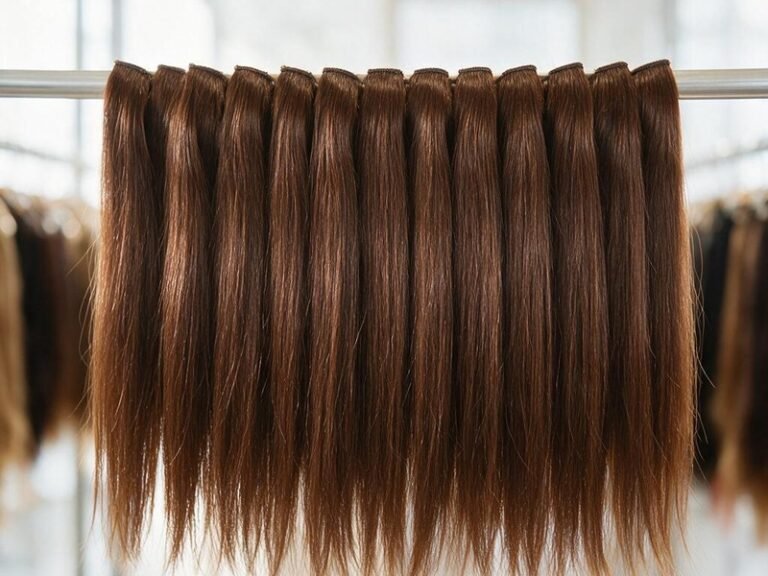
A standard machine-weft bundle weighs 95 to 100 grams, about 3.3 to 3.5 ounces, at any length.
Longer hair costs more because 24- to 30-inch donors are scarcer, not because bundles should weigh more.
Some vendors sell 80-gram bundles cheaper per piece, forcing clients to buy four instead of three.
Compare price per 100 grams and ask for true length—pulled straight, weft to tip—before pricing retail.
When comparing weft hair extensions, weight and length should be on the listing, not buried in chat.
Packaging and MOQ details to confirm in writing
- Custom labels and printed boxes often start at 50 to 100 pieces per style; ask if MOQ is per texture, length, or total order.
- Stock tape in hair and bundles may ship in 3 to 7 days, but branded packaging usually adds 2 to 5 weeks.
- Send a vector logo (.ai or .eps), not a screenshot, or tags can print blurry.
- Rigid boxes add 2 to 6 ounces per order and change postage and free-shipping thresholds.
- Expect a defect allowance near 1 to 3 percent; get replacement rules and photo requirements in writing.
- If braiding is your niche, read this human hair for braiding guide before mixing loose bulk and wefted stock.
- Skip satin tags and custom boxes on the first run until you know what customers actually repurchase.
Private label hair FAQ
Is private label hair the same as custom manufacturing?
Most of the time, no.
Private label usually means branding stock hair—whether bulk hair, wefts, or wigs—with your labels and packaging.
Custom colors, textures, or densities need larger MOQs and lead times, so ask which model you’re being quoted.
What is a realistic first-order MOQ?
For branded stock bundles, 50 to 100 total pieces is common, and you can usually mix lengths within one texture.
Boxes and labels may have separate minimums, so don’t assume the hair MOQ covers packaging.
Start small enough to test reorders, but not so small that unit costs kill your retail margin.
Your label will live or die on consistency, not the first pretty sample.
Weigh the hair, wash the sample, get specs and defect terms in writing, and then place a small branded test order before scaling up.
Send Us Your Hair Inquiry
Need bulk pricing, samples, or a private-label quote? Fill in the form and our team will get back to you within one business day.