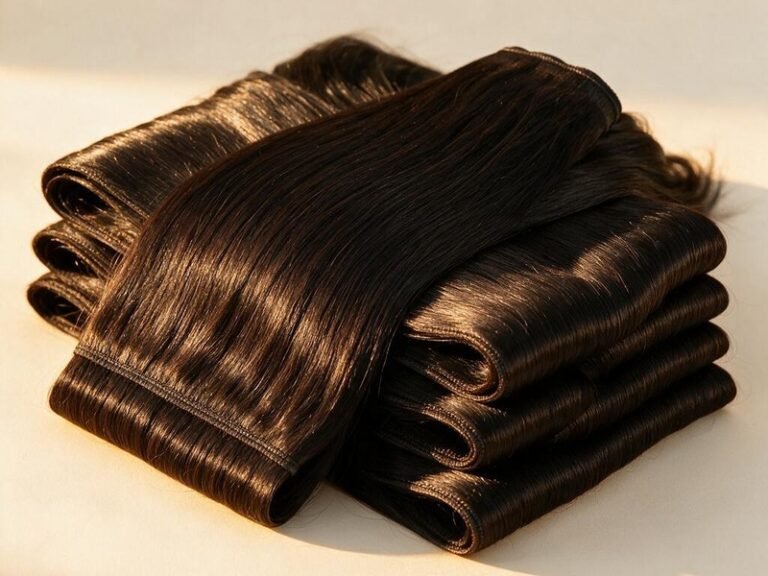
Frontal Wig Human Hair Black: Questions to Ask Before You Order
A black frontal wig in human hair can move well and last a long time, but only if the hair quality, lace type, cap construction, density, and color match your customer base. Before you place a wholesale or salon order, ask specific questions instead of relying on a product title that simply says “100% human hair.”
A frontal wig uses a frontal, which is a lace piece that usually runs from ear to ear across the front hairline. The rest of the wig may be machine-wefted, hand-tied, or a mix of both. Use the questions below to compare suppliers, avoid surprise substitutions, and choose units your braiders, stylists, or resale clients can actually install with confidence.
What exactly is a frontal wig human hair black unit made from?
Start with the hair itself, because “black human hair” is too broad for a buying spec. Ask whether the hair is virgin hair, Remy hair, raw hair, or processed human hair. Virgin hair usually means unprocessed hair that has not been colored or chemically treated before collection; raw hair is a less standardized term often used for minimally processed donor hair; Remy means the cuticles are kept in the same direction, though quality can still vary.
For a black frontal wig, the color may look natural, but even #1B or natural black can be processed. True natural black is rare in many donor markets, and many units are lightly treated to reach a consistent off-black. Ask if the color is natural color, dyed #1, dyed #1B, or blended from multiple batches. If your clients plan to bleach or custom-color the wig, dyed black units may not lift as predictably as natural-color hair.
Also ask if the unit is cuticle aligned, meaning the hair cuticles run from root to tip. Cuticle-aligned hair tends to tangle less and tolerate washing better. A lower-priced unit may still be human hair, but if the cuticles are mixed or stripped, it can matte quickly after shampooing, especially around the nape and behind the ears.
Request the hair percentage in writing. Some markets use wording such as “human hair blend” or “human hair premium mix,” which can include synthetic or animal fiber. For B2B orders, ask plainly: “Is this 100% human hair on both the frontal and the wefts?” Then ask whether the percentage can be shown on the packing list or invoice.
Which lace and frontal size should your clients expect?
The frontal is one of the biggest drivers of cost and customer satisfaction. Most frontals are 13 inches wide by 4 inches deep, commonly listed as 13×4, but you will also see 13×6 units with deeper parting space. A 13×6 frontal gives more styling room, but it costs more and can feel warmer because there is more lace on the scalp.
Ask what lace material is used. Transparent lace, HD lace, medium brown lace, and Swiss lace are common terms, but they are not applied consistently by every factory. HD lace usually refers to a very thin, sheer lace designed to disappear more easily on complexions, while transparent lace is often a light, neutral lace that needs tinting for deeper skin tones. Ask for actual photos or a sample swatch before ordering a large batch.
p>Lace color matters especially for black wig buyers because a lace that is too light can look gray or ashy at the hairline. Your stylists can tint lace, but resellers selling ready-to-wear units may prefer a more forgiving neutral or light-brown lace. Ask whether the lace can be selected separately, whether knots are lightly bleached, and whether the hairline comes pre-plucked.
Pre-plucked hairlines save time, but over-plucked units can look thin or unrealistic. Ask for the baby hair style: none, natural light, moderate, or dramatic. For salon sales, many buyers choose lightly pre-plucked units so stylists can customize. For quick retail sales, a modest pre-made hairline may reduce returns, but avoid units with overly shiny lace or obvious uniform hairs.
What wig density and texture fit your market?
Density is the amount of hair on the wig cap, usually shown as a percentage such as 150%, 180%, or 200%. It does not describe curl tightness; it describes fullness. A 150% density unit can look natural and flat-iron well, while 180% is a common salon balance for body wave and straight black wigs. Densities of 200% or higher look glamorous but cost more, feel heavier, and can be bulky under the cap.
Ask how the supplier calculates density. Some factories measure total hair weight per cap size; others use a looser visual standard. For reference, an 18-inch straight 13×4 glueless wig at 180% density often lands around 180 to 240 grams, depending on cap construction and manufacturer. Curly units may weigh more when measured by hair length because curly hair is measured stretched, but that does not always mean higher density.
Texture is another order detail to confirm. Straight, body wave, loose wave, deep wave, curly, water wave, and kinky curly all behave differently after washing. Ask whether the texture is natural steam-set or chemically processed. Steam-set textures generally revert better after washing, while stronger chemical textures may loosen over time.
For a frontal wig human hair black style, also ask about length. True length should be measured from the crown or weft to the longest point, with curly hair pulled straight. Common salon inventory starts at 10 to 14 inches for bob units, 16 to 22 inches for everyday wear, and 24 inches or longer for statement looks. Longer lengths cost more and need more maintenance, so avoid overstocking 28-inch units unless your clients already ask for them.
What cap construction and install method are being sold?
An install is the method used to attach the wig or hairpiece. Frontal wigs can be glued, sewn down, clipped in, worn with an elastic band, or made glueless with combs, adjustable straps, and sometimes silicone grips. Ask which construction the unit uses before comparing prices, because a traditional cap and a true glueless cap are not the same product.
Common cap terms include machine-made wefted caps, half hand-tied caps, full lace caps, glueless wear-and-go caps, and caps with stretch panels. A weft is a stitched track of hair sewn into the cap. Most 13×4 frontal wigs use a lace frontal at the front and wefts through the back. That construction is durable and more affordable than a full hand-tied cap, but high ponytail styling may be limited.
Ask these cap questions before you commit:
- What is the frontal size: 13×4, 13×6, or another measurement?
- Does the cap have adjustable straps, combs, elastic bands, silicone, or stretch material?
- What cap sizes are available: petite, average, large, or custom circumference?
- Are the back and sides wefted, hand-tied, or a hybrid?
- Can the unit be worn in a high ponytail without showing tracks?
- Are the knots bleached, and is the hairline pre-plucked?
- Does the price include custom styling, cutting, baby hairs, or special packaging?
Average cap circumference is often around 21.5 to 22.5 inches, but factory specs vary. Ask for the exact measurements in inches: circumference, ear to ear across the forehead, nape to forehead, and temple to temple around the back. If you sell retail to end users, including a measuring guide can reduce size returns. If you supply salons, average caps with adjustable straps are usually the safest starting inventory.
How do you verify quality, MOQ, lead time, and return terms?
Before ordering, separate sales language from factory facts. Ask for production photos or videos of the exact batch, not only studio images. For repeat orders, request sample lengths, texture, and density standards so both sides know what “180% body wave 1B” means. A sample order may cost more per unit, but it is cheaper than receiving fifty units that shed, smell processed, or have mismatched curl patterns.
Ask about shedding from both the frontal and wefts. Minimal short hairs near the weft can be normal after brushing, but persistent shedding may point to weak stitching or poorly ventilated knots. Reinforced wefts can help, but they can make the back feel thicker. Knots at the frontal should be secure; heavily bleached knots can be more fragile, so ask whether the supplier recommends sealing them.
MOQ, or minimum order quantity, varies by supplier and customization. Stock black frontal wigs may have a lower MOQ, sometimes a few pieces per style, while custom labels, custom caps, special curl patterns, or colored packaging may require 20 to 100 pieces or more. Ask whether mixed lengths and textures are allowed within one MOQ. Small boutiques often start with 10 to 20 units across best-selling lengths, while larger vendors may order 50 or more to lower unit cost.
Lead time should include production, quality inspection, packaging, and shipping. Stock units may ship in 2 to 7 days, custom wholesale orders may take 10 to 25 days, and busy periods such as holiday sales or prom season can add delays. Ask what happens if a length sells out mid-order and whether the supplier will substitute texture, lace color, or density without written approval.
Return terms need to be realistic. Human hair wigs may not be returnable after wearing, cutting, washing, bleaching, or applying glue, but you should still agree on protection for factory defects. Confirm what counts as a defect: severe shedding, incorrect length, wrong density, lace tears before use, mismatched color, or wrong cap construction. Ask for a claim window, such as photos within 48 to 72 hours of delivery.
Are the maintenance expectations realistic for your buyers?
Even a well-made frontal wig human hair black unit needs proper care. Black hair can show dryness, product buildup, and split ends over time, especially after heat styling. Your clients should detangle gently with a wide-tooth comb or wig brush, wash with sulfate-free shampoo, condition without soaking the knots heavily, and dry the cap fully before storing.
For curly and deep-wave units, ask the supplier for recommended care. These textures often need leave-in conditioner, water-based styling products, and air drying to prevent frizz. Straight and body-wave units can be heat styled, but frequent use of flat irons above 350°F without heat protection can shorten the life of even good human hair.
Lace care matters too. Clients should not scratch aggressively through the frontal, pull the lace while brushing, or apply heavy glue remover roughly. Glueless units still need regular cleaning of the elastic, combs, and interior band. If your customers expect a wash-and-go unit with zero customization, set expectations that lace tinting, baby-hair trimming, and strap adjustment may still be needed.
Give honest guidance on lifespan. With daily wear, adhesive use, heat, and poor maintenance, a wig may show wear in a few months. With rotation, gentle washing, professional customization, and proper storage, a quality human hair frontal wig can last a year or longer. Do not promise a fixed lifespan, because wear depends more on care and installation than the product label alone.
FAQ
Is a 13×4 or 13×6 frontal wig better?
A 13×4 frontal wig is usually more affordable, lighter, and enough for most natural hairlines and side parts. A 13×6 gives deeper parting and more styling room, but it costs more and may need more lace work. Choose 13×4 for general inventory and 13×6 if your clients regularly request deep parts or pulled-back looks.
What density should I order for a black human hair frontal wig?
For everyday wear, 150% to 180% density is usually the easiest range to sell because it looks full without feeling too heavy. Choose 200% or higher for clients who want a very glamorous style, especially in lengths over 24 inches. Confirm the supplier’s density standard by weight and sample photos before ordering in bulk.
Before you buy, send the supplier a short spec sheet covering hair origin, color, texture, length, density, lace type, cap size, MOQ, production time, and defect policy. If you want help narrowing the options for salon retail or wholesale resale, share your target customer and budget, and we can recommend a practical starting assortment.
If you want the full background before you order, our guide on Braiding Hair Human Hair Straight: Questions to Ask Before You Order walks through it in plain terms.
Send Us Your Hair Inquiry
Need bulk pricing, samples, or a private-label quote? Fill in the form and our team will get back to you within one business day.