Hair We Share Donation: What Wholesale Buyers Need to Know
A Hair We Share donation is mainly a consumer-facing charitable hair contribution, not a standard wholesale purchase channel. If your salon, wig studio, extension brand, or nonprofit is sourcing hair for donation programs, you need to verify eligibility directly with the receiving organization before buying bulk inventory or promising clients that donated ponytails qualify.
Wholesale buyers often ask us whether they can buy Chinese factory hair, collect salon cuttings, or donate overstock extensions to organizations like Hair We Share. The short answer is that each charity sets its own rules around length, condition, gray hair, processing, packaging, and whether it accepts extensions or wigs. Your job is to confirm those rules first, then choose a product format that actually fits.
What Is a Hair We Share Donation?
Hair We Share is a nonprofit organization best known for collecting donated human hair and using it to create wigs, especially for people experiencing medical hair loss. A typical donor cuts off a ponytail, makes sure it meets the minimum length, keeps the hair secured at the top, and sends it in following the charity’s instructions. Some programs also accept monetary donations because cutting hair is only one part of wig production.
For wholesale buyers, the key point is that donated ponytails are not the same thing as salon-ready extension inventory. Donated raw ponytails need sorting, sanitizing, processing, wefting or ventilating, knotting, styling, and quality control. A charity may also need specific lengths, colors, textures, and hair conditions to build usable pieces.
A few terms matter here. Virgin hair means hair that has not been chemically processed, such as colored, permed, relaxed, or heavily treated. Remy hair means the strands are kept with roots and ends oriented the same way, usually with the cuticle layer in better order. Raw hair generally means unprocessed donor hair with minimal steam or chemical texture work, while cuticle aligned means the hair cuticles face the same direction to reduce tangling.
Those terms can sound interchangeable in sales messages, but they are not. For charitable wig production, documentation and consistency often matter as much as grade labels. If you are supplying a nonprofit, ask whether it needs raw ponytails, processed wefts, bulk hair, completed wigs, or financial support instead of assuming one product works for every program.
Can Wholesale Companies Donate Human Hair?
Yes, companies may sometimes donate human hair, but acceptance depends on the charity’s current needs and donation policy. Some organizations cannot accept loose factory scraps, mixed-length hair, heavily processed hair, or opened extension packages. Others may prefer financial contributions, finished wigs, or partnerships with licensed manufacturers that can meet sanitation and traceability standards.
If you own a salon or extension brand, client donation drives can still be valuable. You can offer clean cuts, secure ponytails correctly, explain minimum length rules, and help donors mail contributions. What you should avoid is telling customers that every ponytail cut in your shop will become a wig unless the receiving organization has confirmed that it accepts that exact format.
Wholesale donors also have to think differently about liability. Hair collected from many donors can vary in dye history, exposure, texture, length, and hygiene. A factory can sort and disinfect hair, but charity programs may have strict rules about mixing donor sources or accepting hair that has already been made into machine wefts. Bulk hair is loose hair not sewn onto a weft, and it can be more flexible for wig making, but only if the length, alignment, and condition meet the program’s standard.
Before donating overstock, take photos and prepare a packing list showing length, texture, weight, color, construction, processing level, and whether the hair is new and unopened. This helps the charity decide whether the product can be used. It also protects your business from shipping a carton that gets rejected on arrival.
What Hair Donation Requirements Should Buyers Verify?
Requirements can change, so use the organization’s current donation instructions as your final source. Most hair donation programs care about minimum straightened length, secure bundling, clean and dry hair, percentage of gray hair, chemical processing, and whether the hair is swept from the floor or cut directly from the donor. Swept-up loose hair is usually not accepted because root direction gets mixed up and hygiene becomes harder to control.
Here is a practical checklist to use before buying or collecting for a Hair We Share donation program:
- Minimum length: Confirm the exact minimum and measure the hair correctly. Many programs need several inches because some length is lost during wig making; 8 inches is a common charitable donation benchmark, but do not assume that applies to every organization.
- Hair condition: Clean, dry, secured ponytails or braids are usually preferred. Wet or moldy shipments can ruin an entire bag.
- Processing rules: Ask whether colored, highlighted, permed, relaxed, or gray hair is accepted. Some charities accept processed hair, while others have stricter limits.
- Direction control: Keep the cut end tied tightly. Hair that arrives loose or root-to-tip mixed may be unusable for high-quality wigs.
- Product format: Ask whether the program accepts ponytails, bulk hair, machine wefts, hand-tied wefts, closures, frontals, or finished wigs. A closure is a small lace or silk piece used at the top or crown, while a frontal runs across the front hairline.
- Packaging and paperwork: Label each bundle by length, color, and donor or batch number. Use breathable packaging for fully dried hair and include any required donation form.
- Shipping timing: Ship promptly after inspection, avoid storing damp hair in plastic, and use a tracked service so the charity can confirm receipt.
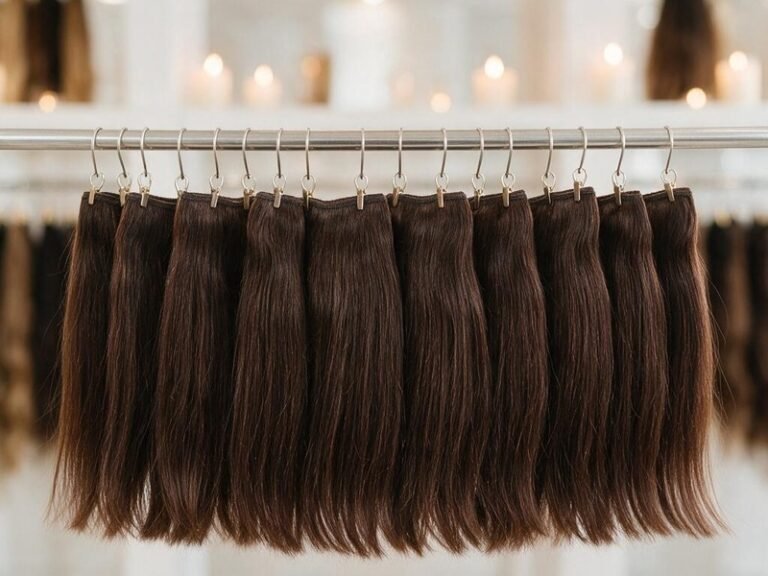
Wholesale buyers should also understand the difference between donation hair and retail extension hair. A 100-gram machine weft may be perfect for a sew-in, but it is not automatically suitable for a medical wig. A weft is hair sewn into a track for extension installation, while wig ventilation often uses bulk hair tied into a cap. Buying the wrong construction can waste money even when the hair itself is good quality.
How Do Wholesale Buyers Source Donation-Quality Human Hair?
Start with the end use, not with a factory price list. If the charity needs unprocessed ponytails, ask suppliers for donor hair that is clean, sorted, root-direction correct, and available in the accepted minimum length. If the organization can accept finished wigs, you need a manufacturer that can consistently produce cap construction, density, lace type, sizing, and ventilation that match the recipient’s needs.
Density means how full a wig or unit looks, often expressed as a percentage such as 130%, 150%, or 180%. Higher density uses more hair and costs more, but it is not always better for someone wanting a natural look or a lightweight medical wig. For charitable units, comfort, cap security, scalp sensitivity, and realistic hairline work may matter more than selling a heavy wig.
When sourcing from China or another wholesale market, ask specific questions instead of relying on words like “premium,” “10A,” or “donation grade.” Those labels are not universal standards. Request batch photos, length checks, weight per bundle, close-ups of the cuticle, shedding tests, tangle tests after washing, and details on steam processing or chemical treatment. If possible, order a sample before committing to a larger run.
For example, raw temple or donor hair can be excellent, but supply can be uneven and minimum order quantities may be high. Remy cuticle-aligned hair is often more consistent for commercial pieces, but it may still be lightly processed to match texture or color. Nonprofit programs may accept either one; the issue is whether you disclose the treatment honestly and match the charity’s specifications.
Typical wholesale MOQs vary by product. Basic machine wefts may start around 10 to 50 pieces depending on the supplier, custom colored or textured orders often require larger runs, and custom wigs can have per-piece pricing that changes with cap design and density. Lead times commonly range from 3 to 10 business days for stock goods and 2 to 6 weeks for custom production, with longer windows during holiday peaks. Treat those estimates as planning ranges, not universal promises.
Can a Salon or Extension Brand Run a Hair Donation Drive?
A donation drive can work well if you keep the scope narrow and the instructions visible. Tell donors the minimum length, whether gray or colored hair is accepted, how hair must be secured, and whether the charity accepts hair from all ages and hair types. Have stylists measure before cutting, because donors sometimes overestimate how much length they can spare.
Use a simple intake process. Hair should be freshly washed, completely dry, brushed into a ponytail or braid, and secured tightly above and below the cut if needed. Place each donation in a separate labeled bag with the donor’s length and color information. Never combine floor sweepings with ponytail donations.
If your brand sells extensions, be careful with marketing language. A customer buying a tape-in, which is a thin adhesive weft applied near the root, or a k-tip, which is a keratin-bonded strand-by-strand extension, should not be told that used extension pieces are automatically accepted by donation charities. Used hair may carry product buildup, bond residue, shed fibers, or mixed cuticle directions.
An install is the professional application of extensions, and removal should always be handled so the natural hair and extension hair stay organized. If clients ask about donating after removal, explain that most programs want cut ponytails rather than worn tape-ins or bonded hair. Your salon can still support the cause by collecting fresh cuts, sponsoring wig production, hosting education events, or making a monetary donation.
What Are the Main Buyer Risks and Trade-Offs?
The biggest risk is mismatched expectations. A charity may need 12-inch ponytails, while your factory offers 8-inch bulk hair at a good price. A nonprofit may require unprocessed hair, while your supplier’s natural black hair has undergone gentle dye or steam texture treatment. Those differences may sound small on a quote sheet, but they can make the donation unusable.
Quality is another issue. Cheap mixed-hair packs can contain synthetic fibers, animal hair, short fillers, reversed cuticles, or excessive silicone coating. Silicone makes hair feel soft at first, but after a few washes it can become dry or tangled. Do a burn or fiber identification check only if you know how to do it safely; more reliable B2B checks include supplier samples, wash tests, vendor declarations, third-party inspection, and consistent batch comparisons.
There is also a real cost difference between donating hair and funding a wig. Even a long ponytail does not become a wearable unit without professional processing and construction. Lace, caps, labor, styling, sizing, packaging, and shipping all add expense. For some organizations, a monetary contribution may be more useful than sending hair that does not meet the current production need.
If your goal is client goodwill, do not turn the campaign into a sales gimmick. Be transparent that donation acceptance is controlled by the charity, not your store. If you are buying wholesale inventory for a community project, choose specifications that serve the recipient and get approvals in writing before production. That approach prevents disappointment and keeps the program credible.
FAQ
Can wholesale hair extension buyers donate overstock to Hair We Share?
Sometimes, but not automatically. Hair We Share or any receiving charity must confirm whether it accepts new wefts, bulk hair, closures, frontals, wigs, or other stock formats. Always share product details and photos first, including length, weight, processing, packaging, and construction.
What type of human hair is best for donation programs?
The best hair is whatever the organization’s current program accepts, usually clean, dry, securely bundled, minimum-length hair with clear processing history. For custom wig manufacturing, sorted bulk hair with aligned cuticles is often more practical than machine wefts, but the charity’s requirements come first.
Should a salon buy Chinese wholesale hair for a charity wig project?
It can make sense if the supplier can provide consistent quality, honest processing details, samples, and the exact hair format the project needs. Do not purchase until the nonprofit approves the specifications, and test one sample for shedding, tangling, texture return, and dye behavior before scaling the order.
If you need help comparing bulk hair, wefts, or custom wig specifications for a charitable project, tell us the required length, quantity, texture, and accepted processing level. We can help you choose a practical format before you commit inventory or market a donation program to your clients.
If you want the full background before you order, our guide on Buy Hair Extensions Wholesale Australia: What Wholesale Buyers Need to Know walks through it in plain terms.
Send Us Your Hair Inquiry
Need bulk pricing, samples, or a private-label quote? Fill in the form and our team will get back to you within one business day.