Human Hair Extensions: A Complete Buyer’s Guide
The short version: human hair extensions are usually the best choice for salons, braiders, wig makers, and resellers because they style more naturally, last longer than synthetic hair, and can be washed, colored, curled, and straightened with proper care. The catch is that “100% human hair” alone does not tell you much—hair quality, cuticle direction, donor processing, donor region, construction, and factory consistency matter just as much.
This guide walks through the terms, product types, sourcing decisions, pricing red flags, and care instructions that matter when buying wholesale human hair extensions. Use it before you place a bundle, closure, frontal, tape-in, k-tip, or bulk hair order.
What Are Human Hair Extensions?
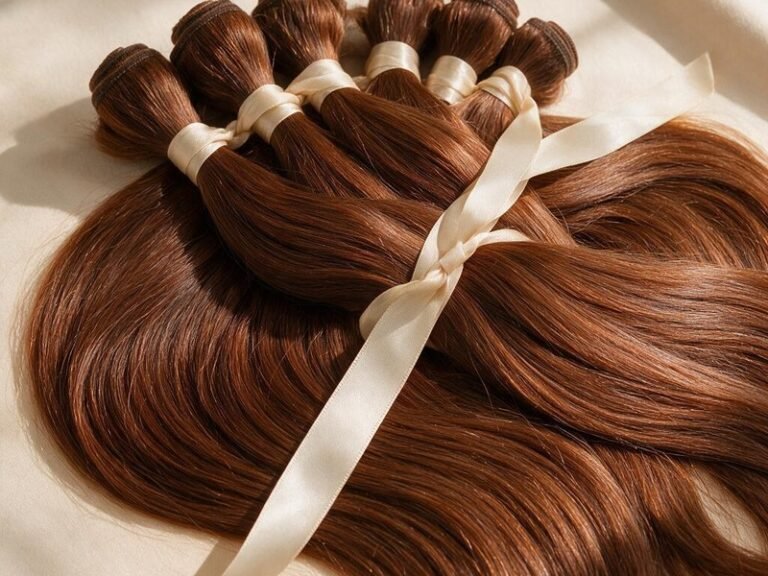
Human hair extensions are lengths of real donated or collected hair attached to a weft, wig cap, strand-by-strand bond, or left loose as bulk hair for braiding. A weft is a stitched or reinforced track that holds the hair together so it can be sewn in, clipped in, or made into a wig. Bulk hair has no weft and is commonly used for knotless braids, boho braids, or custom strand work.
You will see several quality terms in product listings. Virgin hair means human hair that has not been chemically processed, relaxed, permed, dyed, or bleached by the supplier. Raw hair usually means minimally processed hair that comes directly from a donor or collector and is then washed, sorted, and made into product without a heavy steam or acid bath. Raw hair can vary more in texture and color because it is less standardized.
Remy means the hair strands were kept with the cuticles facing the same root-to-tip direction. Cuticle aligned hair means the same thing in practical terms: the outer protective cuticle layer runs one way, which reduces tangling and matting. Be careful here—Remy is sometimes used as a marketing label even when the hair has been stripped or coated. Ask for photos, videos, wash tests, and small sample orders before trusting the tag.
Non-Remy hair is collected from brushes, salon floors, temples, or mixed sources where root and tip directions may be reversed. Factories sometimes remove cuticles and add silicone to make the hair feel soft initially. That hair can look good for the first few washes, then become dry, tangle, or shed once the coating wears off.
Which Human Hair Extension Types Should You Stock?
The best product mix depends on your clients, install method, price range, and how much inventory you want to carry. Hair sold for quick makeovers may call for clip-ins or headband wigs, while a salon doing long-term professional installs may want tape-ins, k-tips, sew-in bundles, closures, and frontals.
A closure is a small lace or silk base piece, usually 4×4, 5×5, or 6×6 inches, used to close a sewin or wig at the top or crown. A frontal is a wider piece, commonly 13×4 inches, that runs from ear to ear and allows more styling options, such as ponytails and pulled-back looks. Frontals usually take more skill to install and maintain than closures.
Here are the main categories B2B buyers compare:
- Bundles and machine wefts: the most common sewin and wig-making product, usually sold by length and weight; standard single bundle weights are often around 95–105 grams.
- Bulk hair: loose hair without a weft, used for braiding, loc repairs, custom ventilating, or strand-by-strand applications.
- Tape-in extensions: thin sandwich-style wefts bonded near the root with adhesive tabs; an install is the professional application method, and maintenance is usually needed every 6–10 weeks as the natural hair grows.
- K-tip extensions: individual strands tipped with keratin, sometimes called fusion hair; installed with heat or a melting tool and often worn for 3–5 months before removal or reinstallation.
- Clip-ins: wefts fitted with pressure-sensitive clips for temporary wear; good for bridal trials, events, salon retail, and first-time extension customers.
- Closures and frontals: lace or silk-based pieces that create a natural-looking part and hairline without leaving protective styling hair out.
- Wigs and HD lace units: completed cap constructions made with bundles and lace; density, lace type, cap size, stretch, bleached knots, and band placement all affect fit and cost.
If you are a new reseller, start narrow. Three body wave bundle lengths, one straight texture, one deep wave texture, and a few 4×4 or 5×5 closures are easier to control than a huge catalog of every curl pattern and color. Once repeat orders prove the texture, add frontals, colored hair, tape-ins, or custom wig labels.
What Is the Difference Between Raw, Virgin, Remy, and Cuticle Aligned Hair?
These terms overlap, and that is why buyers get confused. Virgin hair describes chemical history, Remy describes cuticle direction, and raw hair describes processing level. A bundle can technically be virgin and Remy, raw and cuticle aligned, or labeled virgin without being consistently high quality.
Raw hair is usually the least standardized. It may come in natural straight, natural wave, curly, or coarse textures, and the pattern can change after washing. That variation is normal, but it can be a problem if your customers expect every batch to look identical. A good factory should sort donor texture, length, and color carefully and disclose natural variation before shipment.
Virgin hair is often steam-processed to create consistent textures such as body wave, deep wave, loose wave, or kinky curly. Steam is gentler than a harsh chemical perm, but repeated high heat, poor sorting, or aggressive processing can still weaken hair. If your supplier offers every texture in perfectly uniform shine with no natural ends, ask exactly how the pattern was set.
Cuticle aligned hair tends to be the safer salon purchase because properly aligned cuticles reduce friction, tangling, and dryness. You can test direction by running your fingers along the strand: hair should feel smoother from root to tip than from tip to root. Do not rely on touch alone, though—silicone coatings can hide poor cuticle work until the hair is washed.
How Do Hair Length, Density, and Weight Work?
Length is measured when the hair is pulled straight, even for curly and wavy textures. A 20-inch deep wave bundle may appear several inches shorter in its natural curly state. Always list measurements this way in your store or salon menu so clients do not think they received the wrong length.
Density usually refers to how full a wig, closure, or frontal is. It is stated as a percentage, such as 130%, 150%, 180%, or 200%. Higher density uses more hair and costs more, but it is not automatically better. A 130%–150% density unit can look realistic for everyday wear, while 180%–200% density may suit clients who want a very full style or longer lengths that need more volume to avoid looking thin at the ends.
For bundles, weight and number of bundles matter more than density. Many sewin installs use about 3–4 bundles for lengths 12–20 inches and 4–5 bundles for 24 inches or longer. Longer bundles usually have shorter hair fillers near the weft unless you are buying premium single-donor or specially sorted hair, so the ends may look thinner even when the total gram weight is correct.
Ask suppliers for the exact grams per bundle, grams per pack, number of wefts per pack, and whether the closure or frontal is measured by hair length or lace dimensions. For tape-ins, ask for grams per set and number of pieces; a common retail set may contain 20 pieces and 40–60 grams, but salon full-head installs often need more than one set depending on the client’s natural hair and desired fullness.
Which Hair Textures and Colors Sell Best?
Straight, body wave, deep wave, and water wave remain dependable sellers in many US markets, but local demand varies. Some cities sell mostly sleek natural black bundles, while others want curly textures, blonde highlights, brown balayage, raw Asian wave, or coarse textures that match relaxed and natural hair. Your booking records, social comments, and client questions are better data than a generic bestseller list.
Natural black, often listed as #1 or #1B, is the safest starting color because it can be professionally colored later. Blonde #613 moves quickly in some markets, but it is more fragile because bleaching lifts the cuticle and reduces moisture. If you stock blonde hair, expect more quality checks, more conditioning advice, and a higher chance of complaints from clients who use excessive heat or overlapping bleach.
Colored hair, highlighted piano patterns, ombre, and burgundy tones can give you higher margins, but they also create inventory risk. Colors are harder to reorder exactly because dye lots and donor hair can vary. Start with pre-order or made-to-order color before carrying deep stock in ten shades.
Texture matching is equally important. A frontal with a slightly different curl pattern can ruin an install, especially with curly hair. Buy closures and frontals from the same supplier and, when possible, from the same texture batch as the bundles. Have your stylist wet-set or define the pieces together before promising an exact match.
What Should You Ask a Wholesale Human Hair Supplier?
Start by asking direct production questions, not just “Is it good hair?” A reliable China-based supplier should be able to explain where the hair is collected, whether cuticles are aligned, how textures are set, how products are cleaned, what percentage of short hairs are allowed, and how they inspect shedding, nits, gray hairs, split ends, and weft strength.
Ask for factory photos or video calls, close-up weft images, lace knot details, gram weights, length checks, packaging options, and stock availability. A supplier who only sends polished model photos but will not show the actual product may be trading stock rather than controlling production. That does not automatically mean bad hair, but it usually means weaker consistency and slower problem resolution.
Place a sample order before committing to a large MOQ, or minimum order quantity. MOQs can range from no minimum for in-stock catalog items to 50–100 pieces for custom labels, custom colors, special lengths, or bespoke packaging. Test the hair through at least two washes, air drying, heat styling, coloring on a small section if needed, and brushing from ends upward.
Lead times need to be realistic. In-stock bundles may ship in 2–7 business days, while custom labels, custom colors, wigs, or special textures may take 10–25 days or longer during peak seasons. Add transit time, customs clearance, warehouse receiving, and quality inspection before promising clients a delivery date.
How Do You Compare Prices Without Buying Cheap Hair?
Low prices can come from real cost savings, but they can also come from mixed hair, reversed cuticles, excessive short hairs, thin wefts, heavily bleached lace, high silicone, or weak construction. If one supplier’s 24-inch raw curly bundle is far below every comparable quote, ask why before ordering. Long lengths, true cuticle alignment, and strong curl consistency all use more labor and better raw material.
Compare quotes using the same specs: hair type, donor region, length, texture, grams per piece, weft width, lace color, lace thickness, density, cap size, packaging, label customization, and inspection standard. A 100-gram bundle is not the same as an 85-gram bundle, and a 13×4 frontal with 16 inches of hair is not the same as a short-density budget piece.
Do not overpay for vague grade names such as “10A,” “12A,” or “millionaire grade.” These grade labels are not universal standards. One vendor’s 10A can be another vendor’s mid-tier hair. Build your own private standard instead: aligned cuticles, minimal shedding, true length, accurate weight, clean wefts, consistent curl return, low gray-hair ratio, and no bad smell after washing.
For repeat business, calculate landed cost, not product cost alone. Include shipping, payment fees, customs or brokerage charges, packaging, replacement rate, customer service time, and the labor cost of fixing bad installs. A slightly higher bundle that survives three reinstalls can be more profitable than a cheaper bundle that generates returns and damages your reputation.
What Are the Real Quality Checks Before You Resell or Install?
Inspect every order the day it arrives. Check bundle tags, lengths, texture, color, smell, weight, weft stitching, and whether closures or frontals match the bundles. Measure curly and wavy hair after pulling it straight, and use a small digital scale if weight is part of your product promise.
Run your fingers along the hair in both directions, but do a wash test before judging softness. Human hair with a heavy temporary coating may feel extremely silky when dry, then become coarse or tangled after shampooing. Use a gentle sulfate-free shampoo, lukewarm water, and conditioner from the mid-strands to the ends. Let a sample air dry, then observe curl return, flyaways, shedding, and tangling.
Check the weft by gently holding the track and giving the hair a light pull near several points. A few loose hairs are normal from manufacturing and handling, but continuous shedding, open stitching, holes, or hair pulling cleanly from the weft is not. For lace pieces, inspect knot density, hairline plucking, bleaching spots, lace tears, stretch, ear tabs, and combs or bands.
If you plan to color the hair, test a small hidden section first. Even good human hair can react differently to bleach, especially #613 hair or already colored stock. Salon professionals should use controlled developer strength, deep conditioning, and toning rather than treating every bundle like unprocessed virgin hair.
What Hair Extension Care Instructions Should Clients Receive?
Good hair can still fail quickly with poor home care. Give every client written instructions, especially for frontals, wigs, curly hair, blonde hair, tape-ins, and k-tips. A short care card reduces misunderstandings and protects both the stylist and supplier.
Clients should detangle before washing with a wide-tooth comb or extension-friendly brush, starting at the ends and working upward. Shampoo in a downward motion, avoid scrubbing the bonds or rubbing hair together, and condition the mid-lengths and ends rather than the attachment area. For tape-ins and k-tips, clients should wait the installer’s recommended time—often 24–48 hours—before washing or tying the hair tightly.
Let hair air dry when possible and use heat protectant before curling or flat ironing. Excessive heat, heavy oils directly on lace or adhesive, alcohol-heavy styling products, and sleeping on wet hair can cause tangling, slip, frizz, or lace damage. A silk or satin bonnet, pillowcase, or loose braid helps protect the style overnight.
Curly and wavy hair needs moisture to keep the pattern defined. Clients should avoid heavy grease that coats the hair and instead use leave-in conditioner, water-based curl products, and gentle styling creams. Remind clients that natural curly hair will shrink when dry, frizz in dry weather, and require more maintenance than straight hair.
Common Buyer Mistakes That Hurt Margins
The first mistake is buying too many long lengths. Hair over 24 inches costs more, has higher expectations, and can sit in inventory longer if your market mainly buys 14–20 inches. Buy a few statement lengths for photos or custom orders, but keep your core stock tied to actual demand.
The second mistake is mixing suppliers within one client install. Even if two vendors call the hair “Brazilian body wave” or “raw curly,” the donor hair, luster, curl pattern, processing, and color can differ. Match bundles, closures, and frontals from one production source whenever possible.
The third mistake is ignoring construction details. Thin tape tabs can peel, bulky k-tips can be uncomfortable, weak wig bands can stretch, and poorly ventilated lace can look fake. Your clients judge the finished look, not the raw hair in isolation.
The fourth mistake is promising “no shedding” or “no tangling” forever. All hair extensions shed a few strands, especially during cutting, sewing, and first brushing. The realistic promise is minimal shedding with proper installation and care, strong wefts, aligned cuticles, and support if a product arrives defective.
Frequently Asked Questions
Is 100% human hair the same as good-quality hair?
No. “100% human hair” only describes the fiber source; it does not prove the cuticles are aligned, the hair is unprocessed, or the weft is well made. Some human hair is mixed, stripped, coated, or poorly sorted, so check wash performance, grams, weft strength, return rate, and supplier consistency.
How many bundles does a client need?
Most sewin or wig installs need about 3 bundles for 12–16 inches, 3–4 bundles for 18–22 inches, and 4–5 bundles for 24 inches or longer. A closure or frontal covers the top, but longer styles still need enough bundle weight to keep the ends full.
Is raw hair really better than virgin hair?
Raw hair can be excellent because it is minimally processed and often has a very natural look, but it is less uniform in texture and color. Virgin steam-textured hair can be the better choice if you need repeatable curl patterns and predictable stock. Buy samples first instead of assuming raw always performs better.
How long do human hair extensions last?
Sew-in bundles and wigs can often last 1–3 years with gentle care, professional reinstallation, and proper storage, depending on hair quality. Tape-ins usually need adjustment every 6–10 weeks, while k-tips may stay in for several months before professional removal and reinstallation.
If you are building a wholesale order, send us your target textures, lengths, quantity, packaging needs, and market price range. We can help you compare realistic specs and choose a small test batch before you commit to larger inventory.
If you want the full background before you order, our guide on Clip in Hair Extensions Human Hair: Sourcing Tips for Vendors and Salons walks through it in plain terms.
Send Us Your Hair Inquiry
Need bulk pricing, samples, or a private-label quote? Fill in the form and our team will get back to you within one business day.