Bulk Hair for Clip-In Manufacturing: Weight Per Piece Standards
If you’ve ever sourced bulk hair for clip-in manufacturing to build your own line, you know a single 10-gram weight mismatch per piece can tank your margins, leave customers complaining sets feel thin, or leave you with piles of unused hair you paid a premium for. We’ve watched dozens of new brand owners guess their way through weight specs, only to end up with finished sets that don’t match their price point, or hair that arrives so mis-sorted their production team wastes 15+ hours a week weighing out strands. This isn’t textbook stuff—it’s the numbers we measure every single day in our warehouse when we pull orders for clip-in brands across the US.
The baseline weights every clip-in maker starts with
If you’re browsing wholesale bulk hair for your next clip-in run, don’t just order by total kilogram weight without breaking down what each individual piece in your set needs to weigh. First rule: All weights we talk about here are for hair only, not the metal clips, silicone backing, or stitching thread used to assemble finished pieces. That sounds obvious, but it’s the single most common miscalculation new makers make.
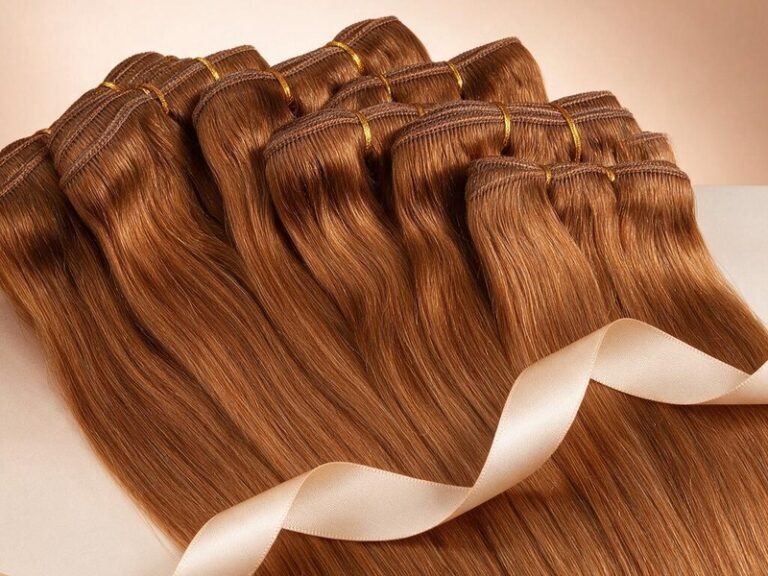
Most mid-tier clip-in sets sold in the US land at 120g total hair weight for 10-16 inch lengths, 160g for 18-22 inch, and 220g for 24+ inch lengths. Those totals are split across 7 to 9 individual weft pieces, cut to different widths to fit the shape of a customer’s head, from the wide nape of the neck up to the narrow crown.
For reference, the per-piece breakdown for our most commonly requested spec, an 18-inch 160g straight hair set, looks like this:
- Two 32g wide back wefts (8 inches wide, 3 clips each, for the lowest nape section)
- Two 22g mid-head wefts (6 inches wide, 3 clips each, for the section just above the nape)
- Two 15g upper side wefts (4 inches wide, 2 clips each, for the area above the ears)
- Two 8g temple wefts (2 inches wide, 1 clip each, for the soft hairline around the face)
- One 6g crown weft (1.5 inches wide, 1 clip, for blending at the top of the head)
Luxury sets in the $200+ price point usually bump each piece by 15-20% across the board, so that same 18-inch set hits 180-200g total, with enough density that customers can pull their hair half up without seeing gaps or thin spots. Budget lines often run 10-15% lighter, but as we’ll get to, skimping too much causes problems fast. Also, plan to order 5-7% more hair than your total per-piece math adds up to — you’ll lose a small amount to trimmings when you even up weft ends and cut pieces to width.
Why off-spec weight will kill your margins faster than bad hair quality
Last quarter, we worked with a new brand owner out of Atlanta who ordered 50kg of straight bulk hair to make 14-inch 120g sets. He did all his math, but counted clip and thread weight as part of his 120g set total. Each finished set came out 18g light on actual hair. He had two bad choices: eat 15% of his projected profit per set to add extra hair, or sell thin sets that left customers complaining. He chose to add the hair, and his first launch barely broke even.
Weight inconsistency doesn’t just hurt your bottom line on the front end, either. If pieces are too heavy — especially the tiny temple and crown wefts — they tug on a customer’s fine natural hair, cause breakage around the hairline, and lead to returns. If weights are uneven across a set, say one temple piece is 6g and the other is 12g, customers will feel that lopsided fit even if they can’t name the issue, and leave reviews saying the set feels “cheap” or “poorly made”.
You don’t have to weigh every single strand that comes through your production door, but using a simple AQL sampling plan for bulk hair will catch 90% of weight inconsistencies before your team starts cutting and sewing, without wasting hours of labor. We’ve seen teams spend 20+ hours a week re-weighing finished pieces because they skipped incoming weight checks, and that labor cost adds up way faster than the 30 minutes a batch it takes to run a proper sample check.
Weight shifts across hair textures (don’t copy straight hair specs for curls)
Here’s another gotcha we see all the time: Makers take the per-piece weights they use for straight hair, apply them directly to curly or coily textures, and end up with sets that look like giant puffs sitting on top of a customer’s head. Curly and coily hair takes up far more volume per gram than straight hair, because the bends and coils in each strand create air gaps. A 10g piece of 3c/4a kinky curly hair will look twice as thick as a 10g piece of silky straight hair from the exact same donor batch.
For kinky curly clip-ins, most established brands drop per-piece weights by 20-25% across the board, so that same 18-inch set lands at 120-130g total hair weight, but looks just as full and lush as a 160g straight set. For wavy textures, drop weights by 10-12% to avoid that bulky, helmet-like look at the roots.
Hair quality changes weight math too. Heavily processed non-Remy hair, the kind that’s been acid-washed to strip cuticles and coated in silicone to feel soft, has thinner individual strands than intact cuticle Remy hair. That means you’ll need 10-12% more grams per piece to hit the same visual fullness as a Remy set. A lot of new makers get lured in by $15/100g non-Remy pricing, only to realize the extra hair they need to add makes the total cost almost identical to better quality stock, with a shorter product lifespan for customers.
If you’re switching from cutting and wefting bulk hair in-house to using pre-made machine weft hair to speed up production, adjust your weights too. The stitching thread used to hold wefts together adds 2-3% of weight per linear foot, so you’ll need to trim a tiny bit of hair per piece to stay on spec, otherwise your finished sets will be slightly heavier than intended.
Factory shortcuts that throw off your entire weight calculation
Even if you do all your per-piece math perfectly, a bad bulk hair shipment can derail your entire production run. We’ve seen every low-cost supplier trick in the book, and almost all of them mess with your weight counts.
The most common trick is mixing in short filler strands — 2 to 4 inch pieces of hair mixed in with full-length stock. The total bundle weight adds up on the scale, but when you go to cut your long clip-in pieces, 15-20% of that weight is too short to use, leaving you short on usable hair. You can spot this fast by pulling a small section from the bulk bundle, holding it upright at the root end, and fanning the strands out. If more than 10% of the strands are 3+ inches shorter than the labeled length, you’re going to deal with excess waste.
Another trick is weighing hair immediately after washing and conditioning, before it’s fully dried to industry standard moisture levels. Wet hair can hold 8-10% of its weight in water, which means by the time the shipment clears customs, travels to your studio, and dries out completely, you’re missing that weight entirely. We once had a customer who ordered 100kg of hair from an unvetted marketplace supplier, and when his order arrived and dried out over three days, it weighed only 91kg — 9kg of water weight he paid premium hair prices for. Properly dried and vacuum packed bulk hair won’t have this issue, because responsible suppliers dry hair to a stable 12% moisture content before sealing packages for ocean or air freight, so weights don’t shift in transit.
Honestly, some suppliers will also pack bundle ends with extra loose hair that falls out the second you open the package, adding 3-5% of “phantom weight” you can’t use in production. That’s why those incoming weight checks we mentioned earlier are non-negotiable, no matter who you order from.
Quick answers to the weight questions we get every week
Do I need to weigh every single clip-in piece during production?
For your first two to three production runs, yes. It takes extra time, but it helps your team build muscle memory for what each piece size should feel like, so you catch mis-cuts early. After that, spot checking 1 out of every 10 pieces is enough, as long as you weigh incoming bulk shipments first. A 5% weight shortfall on a 10kg bulk order is 500g of missing hair — enough for three full 160g sets you already paid for.
Can I run lighter per-piece weights for a budget clip-in line?
Absolutely, as long as you’re transparent about total set weight in your listings. We see brands get in trouble when they sell 100g 18-inch sets labeled as 160g, which leads to fast chargebacks and bad reviews. If you’re selling lighter sets for occasional wear, price them accordingly, and note the weight clearly so customers know what they’re getting. Just know lighter pieces won’t hold curls as long, because there’s less hair density to support the style.
How much extra bulk hair should I order for waste?
Plan for 10% over your total calculated per-piece weight, minimum. If you’re working with tight curly or coily textures that need extra trimming for even ends, bump that to 15%. That extra hair doesn’t go to waste — you can save trim offcuts to make tester pieces, fill custom orders, or make tiny accent clip-ins as free gifts. If you’re nailing down MOQs for your first order, our FAQ page has up-to-date minimums for all textures and lengths, so you don’t overorder on your first batch.
At the end of the day, good clip-ins don’t happen by accident. Nailing per-piece weights doesn’t require fancy equipment or a math degree — it just means doing the math up front, checking incoming stock, and skipping shortcuts that feel like savings until they cost you a launch. If you’re ready to lock in specs for your next clip-in run, reach out to our team with your per-piece breakdown, and we’ll help you calculate exactly how much bulk hair you need, no guesswork required.
Send Us Your Hair Inquiry
Need bulk pricing, samples, or a private-label quote? Fill in the form and our team will get back to you within one business day.