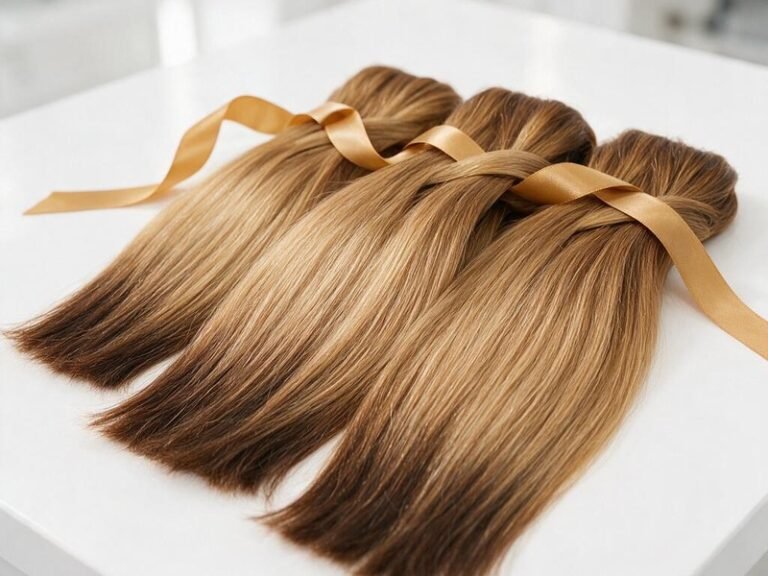
Clip in Hair Extensions Wholesale: How to Avoid Overpaying
The simple way to avoid overpaying for clip in hair extensions wholesale is to compare the full landed cost per usable set, not just the factory’s quoted price per bundle. Cheap hair can cost more after shedding, tangling, returns, re-dyes, color misses, and slow replacements eat into your margin.
If you sell to salons, braiders, beauty-supply stores, or online customers, you need a repeatable buying method: know the hair grade, set weight, construction, clip count, color process, MOQ, freight, and defect policy before placing a deposit. This guide walks through the price points that actually matter and where buyers commonly waste money.
What Are Clip-In Hair Extensions, and Why Do Wholesale Prices Vary So Much?
Clip-in extensions are temporary wefts sewn onto small pressure-sensitive clips that snap into a client’s own hair. A weft is the stitched or reinforced hair track that holds the strands together; with clip-ins, multiple weft sizes are combined into one set for volume and length.
Wholesale prices vary because “human hair” is a broad category. The same 20-inch, 120-gram set can be priced very differently depending on whether the hair is virgin hair, Remy hair, processed temple hair, mixed hair, or hair with a short synthetic content. Virgin hair means unprocessed human hair that has not been perm-ed, dyed, bleached, or heavily coated. Remy means the cuticles are mostly kept in the same direction, which reduces tangling, but the term is often used loosely. Raw hair usually means minimally processed donor hair, and it tends to command the highest price.
Cuticle aligned hair means the hair strands run root to tip in the same direction. That matters because raised or mixed cuticles catch against each other, causing matting after washing. A supplier can call hair “Remy” while still selling mixed-direction hair, so ask how the factory controls cuticle direction rather than accepting the label alone.
You also pay for length, weight, color work, packaging, clips, sewing labor, and quality control. Longer hair is not priced in a straight line: 24 to 30 inches becomes more expensive because long healthy donor hair is scarcer. A low quote may make sense if the set is lighter, shorter, thinner at the ends, or made with heavily processed hair.
The danger is buying from a price sheet without specs. Two suppliers may both advertise “22-inch straight clip-ins,” but one set may weigh 120 grams with 10 pieces and 22 clips, while another may weigh 90 grams with 7 pieces and weak clips. Those are not the same product.
What Is a Fair Wholesale Price Based On: Length, Weight, and Density
Density for a clip-in set usually refers to grams per piece and fullness from top to ends. Many new buyers judge a set by how thick the top of the weft looks, but customers notice thin, wispy ends after one install. An install is the professional application method used to attach extensions; for clip-ins, it is usually a temporary at-home or salon styling service.
A standard everyday clip-in set for fine or average hair often runs around 100 to 140 grams at 18 to 22 inches. Customers wanting dramatic volume may buy 160 to 220 grams, especially in curly textures or lengths over 24 inches. If your quote is unusually low, check the actual total set weight and ask whether the listed weight includes clips, packaging, or both.
Length has a major cost effect. As a rough buyer’s rule, 14 to 18 inches is usually the most accessible everyday range, 20 to 24 inches moves into a higher cost bracket, and 26 to 30 inches requires tighter quality checking because long hair is easier to fake with short hairs tucked into a thick weft. Ask for laid-flat length measurements, because curly and wavy hair should be measured pulled straight.
Do not overbuy density for every customer. Fine hair can struggle to conceal bulky clips, and a 200-gram set may feel uncomfortable for everyday wear. If your market includes salon clients with thin or short natural hair, offer a lighter 100 to 120-gram everyday set and a thicker 160 to 180-gram volume set instead of forcing one heavy SKU.
Fair pricing also means matching texture to the end user. Straight hair is usually easier to source and sort than deep wave, kinky curly, blonde balayage, or gray-blended colors. Those textures and colors can justify higher wholesale costs because they need more processing, sorting, and quality checking.
Which Hair Grade Gives You the Best Margin Without Hidden Risk?
For most B2B buyers, the best margin is not the cheapest available hair and not the most expensive raw hair. It is usually a consistent mid-to-premium Remy or cuticle-aligned human hair set with realistic grams, secure clips, clean wefts, and controlled color batches. That product can support repeat salon and retail sales without forcing you into luxury price pressure.
Budget non-Remy or heavily coated hair may look glossy on arrival. After washing, silicone coatings rinse away, and the hair can become dry, tangled, or hard to style. This is where low-price suppliers win the first order but lose the account. If your customers wear clip-ins only once for events, budget hair may have a place, but it is a bad choice for recurring everyday-wear sales.
Raw or virgin clip-ins can be excellent, but they are not automatically the best business choice. Raw hair has more natural variation, so matching colors and textures across repeated orders can be harder. It also costs more, and many end customers cannot tell the difference once the hair has been colored or styled. If your brand promises long-term reuse and premium quality, raw can work; if you need broad color charts and stable repeat orders, well-processed cuticle-aligned Remy may be more practical.
Ask suppliers direct questions before comparing quotes:
- What percent is human hair, and is there any synthetic or animal-hair mix?
- Are cuticles kept in one direction, and how is that checked?
- What is the total hair weight without clips and packaging?
- How many pieces and clips are included in each set?
- Can the hair be washed, heat-styled, and professionally colored?
- What temperature and chemical processing has the hair already received?
- What is the replacement policy for mismatched color, shedding, or defective clips?
How Do MOQs, Samples, and Bundled Orders Affect Your Real Cost?
MOQ means minimum order quantity, the smallest number of sets or pieces a supplier will accept. A low MOQ helps you test colors and textures, but the unit price is usually higher. A higher MOQ can lower the cost per set, but it ties up cash and increases risk if the texture, color, or length does not sell.
New buyers often overorder fashionable shades and long lengths. Blonde, highlighted, piano color, red, and 26-inch-plus sets can attract attention, but staple shades such as natural black, dark brown, medium brown, and common highlighted browns usually move more steadily. Start with a tight capsule: two textures, three to four lengths, and six to eight proven colors, then reorder based on sell-through.
Samples are worth the cost. Order one or two sets from each supplier in the same length, texture, and color family. Compare gram weight, clip security, weft knots, end fullness, shedding after gentle brushing, smell, shedding after washing, curl return, and color accuracy. Keep notes because hair samples from different months can reveal whether the supplier’s batches are consistent.
Be careful with “free sample” offers that require expensive expedited shipping. Sometimes the total sample cost is the same as paying for the product and selecting slower freight. Calculate the full amount, and use the sample order to test communication speed, packaging, labeling accuracy, and whether the supplier answers technical questions instead of only pushing payment.
Bundled orders can reduce cost if you combine complementary SKUs, such as clip-in sets, closures, frontals, bulk hair, tape-in extensions, or k-tip extensions. A closure is a small lace or silk-base piece used to close a weave style, while a frontal is a larger ear-to-ear piece. Bulk hair is loose hair without a weft, tape-ins use adhesive tabs, and k-tips are keratin-bonded strands. Do not accept a discount bundle unless each category matches the same quality standard; a cheap companion product can drag down your whole brand.
What Supplier Quotes Should Include Before You Compare Them
A fair quote needs more than a unit price. Ask for the price per set by length and texture, set composition, total weight, clip material, packaging dimensions, carton size, gross and net weight, production lead time, shipping method, payment terms, and defect allowance. Lead time can range from roughly 3 to 7 days for stocked standard colors to 2 to 5 weeks for custom colors, private labels, or larger orders, depending on the factory and season.
Freight changes the math. A supplier with a slightly higher product price but better packing, reliable stock, and lower volumetric shipping may be cheaper overall. Lightweight plastic packaging may reduce freight, but flimsy boxes can arrive crushed. Premium magnetic boxes look nice, but if they add weight and dimensional shipping cost, decide whether your customer will pay for that presentation.
Custom labels and branded packaging can help your business, but they can also be an overpay trap in the first order. Start with simple, clean branding and durable protection. Once a shade or texture has repeat orders, upgrade packaging or add custom colors. Private labeling costs less when spread across a larger run, but unused inventory quietly erodes the savings.
Payment terms should match the risk. For a first order, a deposit followed by balance payment after inspection photos or videos is common. Avoid suppliers who pressure you to pay in full before explaining specs, or who refuse to show actual products. At the same time, factories may not offer open terms to new accounts, so build trust through repeated accurate orders before asking for better payment arrangements.
Create a simple comparison sheet with landed cost per set. Include product price, local handling, freight, customs or brokerage fees if applicable, packaging, payment fees, sample amortization, and expected replacement cost. The cheapest quote often loses once you add freight, defects, and customer returns.
What Are the Most Common Quality Problems That Make Cheap Clip-Ins Expensive?
Shedding is one of the biggest hidden costs. Clip-in wefts should be securely stitched, with reinforced holes or stable clip attachment points. Loose stitching causes hair to come out during brushing, and customers may return the set after one wear. Pull lightly along the weft during sampling and brush gently from ends upward to see how much hair releases.
Tangling usually points to cuticle issues, short filler hair, excessive processing, or dryness. Some tangling can happen if a client sleeps in wet hair or uses heavy products, but good-quality clip-ins should not mat severely after normal washing. Use a sulfate-free shampoo, lukewarm water, conditioner from mid-lengths to ends, and air drying on a flat surface when testing.
Dry ends and “hair roots thick, ends thin” construction are common in long, low-cost sets. The top may look full on camera, but the perimeter blends poorly and customers cannot achieve the advertised look. Request end shots and ask for the ratio of long hairs in the set. A 22-inch set should have meaningful hair at the ends, not just a small amount of long strands surrounded by shorter filler.
Color mismatch creates returns, especially online. Monitor calibration, dye lot differences, highlights, rooted colors, and blonde undertones. Natural black can look blue-black under some lighting; browns can pull red or ash; blonde hair can turn brassy or overly white. Order physical color rings or keep retained samples from each approved batch, because screen photos are not enough.
Weak clips cause complaints even when the hair itself is good. Clips should open and close firmly, have rounded edges that do not scratch the scalp, and be sewn evenly so the weft lies flat. Silicone-backed clips can help grip, but the silicone should not peel after a few uses. Curly and thick sets often need more clips or stronger placement than lightweight straight sets.
How Can You Negotiate Without Damaging the Supplier Relationship?
Good negotiation is not about forcing the lowest possible number. Experienced buyers negotiate around order structure, reorder commitment, stock planning, packaging simplification, payment schedule, defect allowance, and freight efficiency. If a supplier cannot reduce the hair price, they may be able to waive label setup, combine cartons, include spare clips, or give a better price on a future reorder.
Give accurate forecasts where possible. Factories plan raw hair purchase, coloring, sewing, and packing around expected volume. A buyer who places small test orders and then gives consistent repeat orders is often more valuable than a buyer who demands rock-bottom pricing on a one-time purchase. Share realistic numbers rather than inflating forecasts just to get a quote.
Ask what changes the price. Sometimes moving from 10 colors to 4 stocked colors, choosing standard packaging, ordering one texture across multiple lengths, or accepting a 15-day production window instead of urgent shipping lowers the cost without hurting quality. Do not ask the factory to reduce the gram weight or hair quality unless you intentionally want a different product tier.
Respect the cost of skilled work. Hand-sewn clip placement, color sorting, curl matching, and inspection take labor. A suspiciously low quote often means one of those steps was skipped. Better suppliers will explain why a blonde 24-inch set costs more than a natural-black 18-inch set; vague suppliers will simply say “premium quality” with no details.
If you work with a China-based supplier, communicate clearly in writing. Use order tables with SKU, texture, length, color code, grams, pieces, clip count, packaging, and quantity. Before production, confirm sample approval and color batch. This reduces disputes and prevents expensive remakes caused by assumptions on either side.
How Should Salons, Resellers, and Beauty-Supply Buyers Choose Their First Wholesale Order?
Salons should buy based on the client problems they see most often. If clients need temporary length for weddings, photoshoots, or special events, stock straight and body wave in 18 to 24 inches. If clients want protective or natural-looking volume, choose textures that match common hair patterns and offer consultation appointments to test color and weight.
Online resellers should avoid a giant catalog at launch. Product photography, returns, and education all become harder when you carry too many shades. Start with best-selling natural shades, one highlighted option, clear length photos, and honest descriptions of grams and clip placement. Customers who understand the product are less likely to buy the wrong weight or color.
Beauty-supply buyers may need broader size runs, but shelf space still matters. Stock the lengths that move, keep deep inventory in natural black and brown, and treat very long or bright colors as limited tests. Reorder by actual sales data, not by which set feels thickest when a sales rep holds it up.
Braiders and stylists who add retail clip-ins to their services can benefit from samples clients can touch. A small sample investment often pays for itself because clients can compare 120 grams versus 180 grams and see the color match in person. It also reduces messages asking whether the hair will blend.
Your first order should be a controlled test, not a bet. Pick one supplier tier, confirm two or three sample sets, order a manageable SKU range, inspect every set on arrival, and track customer feedback for at least four to six weeks. Reorder only when the hair performs after washing and styling, not just when it looks good in the bag.
What Care Instructions Help Protect Your Customers and Your Return Rate?
Quality hair still needs proper care. Advise customers to detangle before washing with a wide-tooth comb or extension brush, starting at the ends and working upward. Clip-ins should be washed gently in lukewarm water, shampooed mostly downward, conditioned from mid-lengths to ends, rinsed thoroughly, and laid flat to air dry.
Clients should avoid sleeping, showering, or swimming in clip-ins whenever possible. Salt water, chlorine, heavy hairspray, and sleeping with damp hair can increase tangling and shorten the life of the set. If a client uses heat, a low-to-medium setting and heat protectant are safer than repeated high heat, especially on colored or curly hair.
Clip placement matters too. Clients should part clean sections, tease or anchor the natural hair lightly if needed, snap the clips close to the scalp without pulling, and distribute weight across several pieces. Fine or fragile hair should not carry an overly heavy set every day. Removing clips gently prevents breakage and keeps the clips from bending.
Include simple care cards or digital instructions with every sale. Clear guidance cuts down on “the hair tangled” complaints caused by over-washing, sleeping in wet extensions, using too much product, or brushing harshly from the root. It also helps customers get more wears, which supports reviews and repeat purchases.
For curly textures, customers should refresh with water and a light leave-in conditioner rather than applying heavy creams that build up on the weft. Curly clip-ins should not be brushed dry; they should be detangled while damp and allowed to reform in their natural pattern. These small instructions protect both the hair and your reputation.
Frequently Asked Questions
Is it cheaper to buy clip in hair extensions wholesale by weight or by set?
For resale, set pricing is usually easier to compare because customers buy a complete wearable product. Still, always verify total hair weight, number of pieces, and clip count, because a “set” can be underfilled. Buying by weight can work for custom builds, but it adds labor if your team has to sew clips and package pieces yourself.
What is the best MOQ for a first clip-in extension order?
A practical first order is usually the smallest MOQ that lets you test several colors and lengths without overstocking. For many new buyers, that means samples first, then 30 to 100 sets across a focused range, depending on budget and sales channels. Reorder fast-moving shades instead of paying for a large discount that sits in inventory.
How can I tell if a wholesale supplier is selling good human hair?
Start with written specs, then test samples after washing, brushing, heat styling, and, if needed, professional coloring. Check shedding, tangling, end fullness, smell, curl return, clip strength, and color accuracy. A trustworthy supplier can explain hair origin, cuticle direction, processing, and weight without relying only on grade numbers or marketing terms.
If you want help building a sensible clip-in assortment, send us your target lengths, colors, budget, and sales channel. We can help you compare set weights, MOQs, and landed costs so your first wholesale order is practical rather than overstocked.
If you want the full background before you order, our guide on Clip in Hair Extensions Real Human Hair Blonde Wholesale: How to Avoid Overpaying walks through it in plain terms.
Send Us Your Hair Inquiry
Need bulk pricing, samples, or a private-label quote? Fill in the form and our team will get back to you within one business day.