Body Wave Bundles Black: What to Check Before Your First Bulk Order
Before placing your first bulk order for black body wave bundles, verify the hair quality, color consistency, bundle weight, curl pattern, return policy, and actual factory lead time. The safest first order is not always the cheapest one; it is the one you can inspect, sell, install, and reorder without surprises.
For US salon owners, braiders, beauty supply vendors, and online resellers, black body wave is one of the steadiest textures because it works for everyday installs, sew-ins, quick weaves, and wig making. But “natural black,” “100% human hair,” and “body wave” can mean very different things depending on the supplier.
What exactly are black body wave bundles?
Body wave bundles are wefts of human hair sewn or machine-made into tracks, with a loose S-shaped pattern that is softer than deep wave and more defined than straight hair. A weft is the stitched horizontal track at the top of the bundle where the hair is secured for sewing, beading, or wig construction.
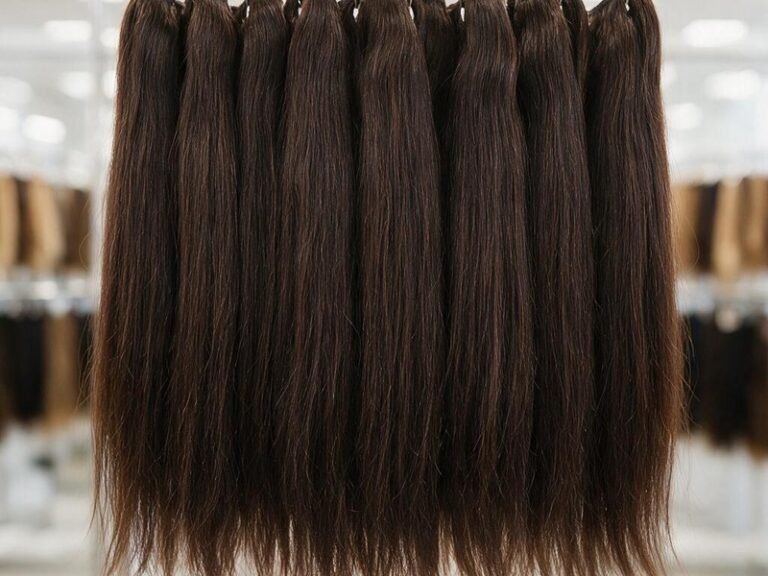
Black body wave bundles usually come in a natural black or off-black shade, often listed as 1B, #1, or natural color. Natural black is not always jet black; it can be a dark brown-black with slight warmth. If your customers expect a true uniform black, ask the vendor for color-ring confirmation or order samples before buying in volume.
The hair itself may be described as virgin hair, Remy, raw hair, or cuticle aligned. Virgin hair means chemically unprocessed hair that has not been colored, permed, or relaxed. Remy means the hair strands were collected with cuticles mostly facing the same direction, though the term is often used loosely. Raw hair usually refers to minimally steamed or processed donor hair, while cuticle aligned means the outer cuticle layer runs in one direction from root to tip, which reduces tangling and matting.
For a first bulk purchase, do not choose based only on those labels. Ask concrete questions: donor source, percentage of human versus synthetic or animal-hair fibers, processing method, steam temperature, whether the pattern will revert after washing, and whether the color is dyed or natural. A reliable vendor should answer directly instead of hiding behind marketing terms.
How do you check body wave texture before ordering in bulk?
Body wave should look like a consistent loose S pattern, not a mixture of beach wave, loose wave, and straight ends. The wave should be present from near the weft to the ends, allowing for a slight looseness at the tips. If one bundle waves tightly and another barely bends, your customers will notice as soon as they open the package.
Always request sample bundles in the exact lengths you plan to sell, preferably 18, 22, and 26 inches, because wave definition can change by length. Longer hair may look looser because the weight pulls the pattern down. Shorter bundles may appear curlier right out of the bag. Compare the sample after washing and air drying, not just fresh from factory packaging.
A practical wash test is simple. Co-wash the sample with moisturizing conditioner, rinse it with lukewarm water, gently blot it with a towel, and let it air dry. Do not brush the hair while it is soaking wet unless the vendor specifically recommends it. Good cuticle-aligned body wave should remain manageable, keep a soft wave, and not turn frizzy, stringy, or straight after one wash.
Run your fingers from top to bottom and then lightly back from tip toward the weft. Hair that feels smooth downward but rough or catches when moving upward may have mixed cuticle directions. Some short cuticle resistance can be normal, but severe snagging, tangling at the nape, or ends that knot after a basic wash are warning signs before a bulk order.
What hair quality details matter most for wholesale orders?
Buyers usually focus on grade names, but grades such as 8A, 10A, or 12A are not universal industry standards. Two vendors can call different hair “10A” and sell completely different products. Your quality checklist should be based on what you can see, feel, wash, measure, and verify.
- Bundle weight: Most wholesale bundles are around 95 to 100 grams per piece, though some vendors sell 100 to 105 grams. Confirm whether the listed weight includes the weft, tag, and packaging.
- Length measurement: Human hair bundles should be measured when the hair is pulled straight. Body wave hair will look shorter in its natural wavy state, especially past 24 inches.
- Short hair ratio: Ask about the amount of short hair near the weft. Too many short pieces make the ends thin and reduce customer satisfaction even if the top looks full.
- Weft construction: Check for tight stitching, loose threads, shedding, thick bulky tracks, and uneven folding. Machine wefts are common; they should be firm but not so thick that they are hard to sew.
- End quality: Run the bundle through your hands and inspect the tips. Dry, split, or plasticky ends are hard to fix and often cause returns.
- Smell and residue: A mild factory smell can fade after washing, but strong chemical odor, oily coating, or heavy silicone buildup is not a good sign.
- Color consistency: Compare multiple bundles under natural light and indoor light. Black hair can look blue-black, brown-black, gray-black, or unevenly dyed.
For a first order, limit your risk by buying sample packs or a small trial batch before committing to hundreds of pieces. A vendor may offer beautiful influencer photos but still ship inconsistent batches. You want to know how the hair behaves after normal shampooing, conditioning, heat styling, and a full install, which is the term for attaching bundles, a closure, or a frontal to create a finished style.
A closure is a small hairpiece, usually lace or silk, used to close the top or side of a sewin without leaving natural hair out. A frontal is a wider piece that runs from ear to ear across the hairline. If you sell sets, test whether the closure or frontal matches the bundle texture, color, luster, and curl pattern; mismatched pieces create obvious complaints.
Should you choose virgin, Remy, raw, or cuticle-aligned body wave?
Most first-time bulk buyers do not need the most expensive raw hair on the market, but they should avoid hair that is merely labeled “human hair” with no details. Your target customer and price point should drive the choice. A salon offering long-term sew-ins may need premium cuticle-aligned hair, while a quick-weave business may choose a more affordable processed option if expectations are clear.
Virgin black body wave can be a strong middle market choice if it is genuinely unprocessed and consistent. It typically has a natural luster, can be colored, and lasts longer than heavily coated hair. The trade-off is that true virgin supply is harder to standardize, so natural black shades and wave patterns may vary more between batches.
Remy hair can perform well if the cuticles are aligned and the hair is not overprocessed. The problem is that “Remy” is often printed on packaging even when the hair has been stripped, coated, or mixed. Ask whether the vendor guarantees cuticle direction, how they control tangling, and what happens if the hair mats after washing.
Raw hair usually costs more and may have a more natural feel, but it is not automatically perfect. Raw textures can be less uniform, and some raw body wave is steamed into the pattern because naturally loose S-shaped donor hair is not always available in large quantities. Steam processing can be acceptable, but excessive steam or chemical treatment can make the wave weak or short-lived.
If your customers plan to bleach, lift, or recolor the hair, test that before bulk ordering too. Natural black hair does not lift the same for every supplier. Use a professional color test on a small section, record the processing time, and watch for breakage or dryness. Hair that sells as “can be colored” should actually survive responsible coloring.
How do you compare bundle weight, lengths, and density?
Bundle weight is one of the easiest places for misunderstandings to happen. In wholesale, a common bundle is about 100 grams, but some suppliers quote 3.5 ounces, 4 ounces, or 100 grams interchangeably even though those weights are not identical. One hundred grams is about 3.5 ounces. Ask for exact grams per bundle and verify random pieces on a scale when the shipment arrives.
Length also needs clarification. Wavy and curly bundles are measured straight, not in their springy state. A 22-inch body wave bundle may appear closer to 20 or 21 inches when hanging in its wave. Customers who do not know this may claim the hair is short, so include measurement guidance in your listings or salon consultations.
Density refers to how much hair is concentrated in a cap, wig, or section, and it affects how full a finished style looks. For bundles sold by the piece, fullness depends on grams per bundle, weft length, short-hair ratio, and how many bundles are used. A typical sew-in may use about three bundles for 14 to 20 inches, three to four bundles for 22 to 26 inches, and four or more for 28 inches and up, depending on desired fullness and head size.
Do not assume heavier always means better. A heavy bundle with lots of short filler hair near the weft can feel thick initially but look sparse at the ends. A well-made 100-gram bundle with even strand distribution often looks and installs better than a heavier-sounding bundle with poor ends.
When ordering sets, decide your standard package early. Many US buyers start with three body wave bundles plus a 4×4 closure, then add longer lengths or a 13×4 frontal as a premium option. Keep length charts, weight labels, and set contents consistent across your store so customers know exactly what they are buying.
What should your first bulk order include?
Start with the shades and lengths that sell fastest instead of ordering every option. Natural black 1B body wave in 16, 18, 20, 22, and 24 inches is a practical first inventory for many US sellers. If your market likes longer installs, add 26 and 28 inches later once you confirm the vendor’s long-length quality and end fullness.
A sensible trial order might be 20 to 50 bundles across five lengths, plus matching closures and a smaller number of frontals. That is enough to inspect consistency, packaging, and turnaround without filling your shelves with hair you have not sold yet. Some factories advertise low MOQs, or minimum order quantities, but the lowest MOQ may come with higher unit prices or less quality control.
Ask whether mixed lengths are allowed in one bulk order. Some suppliers require one length per pack or charge extra for mixed sizes. Also ask whether closures and frontals can be matched to the same production batch. Hair from separate batches may differ in luster or color even when both are labeled natural black.
Packaging matters if you are building a brand. Ask whether the supplier offers plain bundles, private labels, hang tags, satin bags, or custom boxes, and confirm the added cost and lead time. For your first order, keep packaging simple until you know the product itself is stable. Beautiful packaging will not save hair that tangles, sheds, or arrives the wrong shade.
How do you inspect a shipment when it arrives?
Do not wait until a customer installs the hair to inspect the order. Check the carton the same day it arrives, preferably while recording the unboxing in case you need to file a claim. Count bundles, lengths, closures, frontals, and packaging against the packing list before putting anything into inventory.
Lay several bundles from different lengths on a clean table under natural light. Compare color, sheen, wave pattern, weft stitching, and end fullness. Pull each bundle straight gently along a soft measuring tape to confirm length. Weigh a few random bundles with the binding removed if your agreement specifies hair weight only, but keep evidence if weights are off.
Light shedding during stitching or the first comb-through can happen, especially around cut wefts. Excessive shedding in long strands from the track, open weft holes, runs in the stitching, or hair pulling out in clumps is not normal. Seal-cut wefts can reduce shedding after installation, but sealing should not be required to cover up poor construction.
Wash one or two sample pieces from the bulk shipment before selling the whole batch. This is especially important on your first few orders with a new vendor. Check whether the wave stays consistent, whether the hair reverts toward straight, whether the color runs, and whether the ends become dry or tangled.
Take your own photos and short videos in natural daylight after the hair arrives. Factory photos often use extra hair, special lighting, filters, or styled pieces that do not represent an average bundle. Your own wash and install content will also help you set realistic customer expectations and reduce return disputes.
What supplier terms should be confirmed before payment?
Before paying, confirm production lead time, shipping method, tracking responsibility, customs terms, damaged-goods policy, and the window for reporting defects. A standard bulk order may take around 3 to 10 business days to process depending on stock, customization, and order size, but custom packaging or large orders can take longer. Do not rely on a chat message that says “fast shipping” with no dates.
Ask whether the hair is in stock in a US warehouse or shipping from China. Stock location affects speed, replacement ability, and cost. Shipping from China can still work well, but you need realistic transit times and clear customs documentation. During holiday weeks, factory holidays, or peak prom season, add buffer time instead of promising your customers exact dates you cannot control.
Understand the return rules before ordering. Human hair is often treated as a final-sale item once tags are removed or the binding is cut, but reputable sellers should still help with clear factory defects such as wrong lengths, open wefts, severe color mismatch, or confirmed mislabeled products. Ask what evidence they require, whether replacements are allowed, who pays return shipping, and whether refunds are issued as cash or store credit.
Payment safety also matters. For a first order, use a traceable business payment method rather than sending money through informal channels with no invoice. Request a pro forma invoice that lists product, texture, color, length, grams, quantity, unit price, packaging, shipping terms, and delivery timeline. A serious wholesale vendor should not object to basic documentation.
Communication style tells you a lot. If a sales representative avoids questions about fiber content, weight, batch matching, or defects, that is useful information. A good supplier may not be the cheapest or fastest, but they should be consistent, willing to explain product differences, and honest about stock limitations.
Common mistakes that hurt first-time bulk buyers
The first common mistake is buying from a single glamour photo. A model wearing three or four styled bundles can look full and glossy, but that does not tell you how one 100-gram bundle looks wet, washed, air dried, or installed by an average stylist. Request factory videos, bundle photos, measurements, and sample pieces before comparing prices.
The second mistake is confusing luster with quality. Very shiny hair can look appealing in photos, but an unnatural high shine may come from silicone coating. After a few washes, the coating can disappear and leave hair dry or tangly. Healthy human hair usually has a natural sheen, not a plastic-like glare.
The third mistake is ignoring the customer’s install habits. Customers who use high heat, swim often, sleep without wrapping, apply heavy products, or neglect detangling will stress even good hair. Give clear care instructions: use mild or sulfate-free shampoo and moisturizing conditioner, detangle gently from ends upward, air dry when possible, avoid excessive oily products at the roots, and wrap or braid the hair at night.
The fourth mistake is overstocking extra-long lengths. Hair 28 inches and longer looks premium, but it costs more, takes longer to sell, and can develop end-quality issues if the supplier does not control long strands well. Build demand with 18 to 24 inches first, then add longer sizes based on real orders.
The fifth mistake is selling body wave as if it behaves like curly hair. Body wave is a loose texture, and it will usually loosen with brushing, oil, heat, humidity, or washing. Customers who want a very defined curl may prefer deep wave, water wave, or curly textures. Setting that expectation prevents reviews saying the hair “went straight.”
FAQ
How many black body wave bundles do I need for a full install?
Most clients need three bundles for lengths around 14 to 20 inches and three to four bundles for 22 to 26 inches. Lengths 28 inches and up often need four or more because longer bundles usually have less visual fullness toward the ends. Desired volume, head size, weft width, and whether a closure or frontal is used also affect the amount.
Can black body wave bundles be colored?
High-quality virgin or cuticle-aligned human hair can usually be colored by a professional, but results depend on how the hair was processed. Always test a small section first, especially if you plan to lift natural black hair to a lighter shade. Keep in mind that coloring can dry the hair, so deep conditioning and realistic maintenance advice matter.
Final buyer checklist before you commit
Your first bulk order should be treated like a partnership test, not a race to the lowest price. Confirm samples, exact grams, length measurement, color batch, wave retention, weft strength, defect policy, MOQ, lead time, and replacement terms in writing. If those details line up, black body wave can become a reliable core product for salon services, wig making, or retail sales.
Send us your target lengths, quantity, and whether you need matching closures or frontals, and we can help you plan a practical first wholesale order. Starting small, inspecting carefully, and reordering what performs is the steadiest way to build a hair business customers trust.
If you want the full background before you order, our guide on Body Wave Bundles: What to Check Before Your First Bulk Order walks through it in plain terms.
Send Us Your Hair Inquiry
Need bulk pricing, samples, or a private-label quote? Fill in the form and our team will get back to you within one business day.