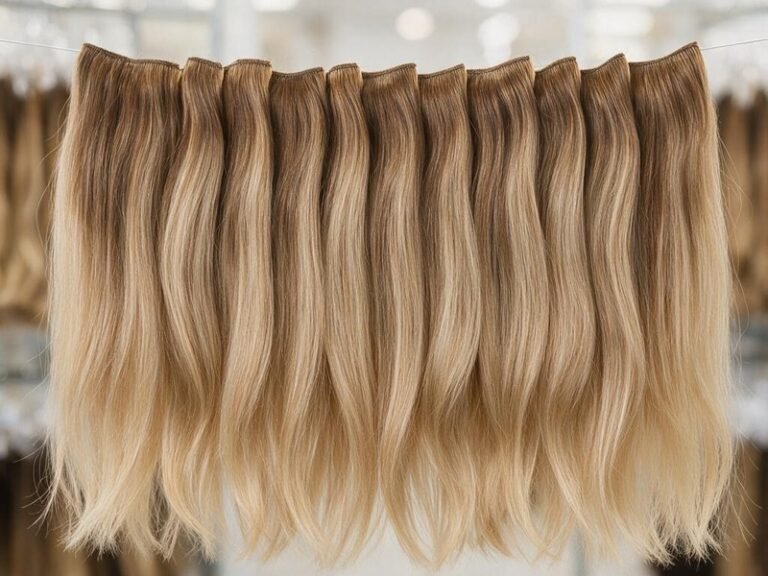
Clip in Hair Extensions Real Human Hair: A Complete Buyer’s Guide
Clip in hair extensions real human hair are human-hair wefts mounted on small snap clips; a full set usually takes 10–20 minutes to apply or remove. For salon or resale buyers, we’d focus on Remy quality, grams, length, color match, clip stitching, and sample/return policies.
Are clip in hair extensions real human hair, and what does that mean?
A clip-in set uses several wefts, or sewn hair tracks, clipped into small sections with metal snap combs.
Real human hair can be washed, curled, flat-ironed, and colored, though it still needs heat and color care.
Remy hair is human hair with cuticles—the outer scales—all facing one direction; cuticle aligned means the same thing.
Virgin hair means never chemically treated, but much clip-in stock is tinted or steamed, so virgin isn’t automatically softer.
A “premium human-hair blend” can hide synthetic or animal fiber, so ask for 100 percent human hair in writing.
How many grams of clip-ins do I need?
Clients shop by inches, but gram weight is where disappointment starts.
A 100–120 gram set suits fine hair, 140–160 grams is the standard full look, and 180–220 grams fits thick hair or major length.
Past 20 inches, most clients need extra grams or the ends will look stringy.
Most sets have 7–10 pieces in mixed widths to spread the weight.
Stock more 16–20 inch standard sets than 24–26 inch ones; long hair costs more and sells slower.
Lifespan and the downsides buyers don’t always hear
With daily wear, good Remy clip-ins often last 6–12 months; occasional wear can reach 18 months to 2 years.
The hair may outlast the clips, so tight stitching matters.
Heat, sulfates, salt water, and sleeping in them dry ends and cause tangling; we see that damage even on quality hair.
They can also pull fine edges, feel heavy, or slip if sections are too thin or freshly conditioned.
Tell clients to brush from the ends, wash after several wears, and store sets flat.
What to inspect before ordering clip-ins in bulk
We always suggest sampling before a bulk order; photos won’t show tangling after combing.
Inspect neat wefts, tight clip stitching, matching color across pieces, and ends that aren’t thin or silicone-coated.
Run hair root to end and back, then shake it; easy tangling is a warning.
Our clip-in bulk quality checks guide covers shed, wash, and color-match tests.
If stylists make custom pieces, they can sew clips onto quality weft hair for hard-to-match clients.
Wholesale price ranges, minimum orders, and lead times
Price tracks length, donor quality, and cuticle alignment, not packaging.
Wholesale, basic human-hair sets often run $15–$30, cleaner Remy $30–$60, and long premium sets $60–$100 or more.
Cheap sets move on price, but we see drier ends, color shifts, and complaints after a few wears.
Stock MOQs, or minimum order quantities, may start at 5–10 sets; custom labels or colors often need 50–100 pieces and 2–4 weeks.
For a wider resale shelf, review our guide to human hair bundles for resale before ordering.
Can clients color and heat-style human clip-ins?
Yes, but lifting dark hair is risky; suggest a strand test, a colorist, and 300–350°F heat with protectant.
Clients should wash out styling product before storage.
Which clip-in set should a new reseller stock first?
Start with natural black, dark brown, and highlighted brown in 16, 18, and 20 inches at 140–160 grams.
Sample two or three suppliers, wash and wear the sets, then reorder the one with least shedding and tangling.
Don’t build your clip-in line from one photo or price chart.
Order samples, have your team test them, then use the shop all hair extensions page to plan stock.
Send Us Your Hair Inquiry
Need bulk pricing, samples, or a private-label quote? Fill in the form and our team will get back to you within one business day.