Best Weft Hair Extensions: Pricing, Quality & Red Flags Explained
The best weft hair extensions are cuticle-aligned Remy or virgin human hair on a tight, even track, with wholesale bundles running $15–$60+ depending on length, origin, and quality. A weft is the horizontal track braiders sew or bead in, and the wrong one means shedding, tangling, and salon chargebacks. Here’s what we’ve learned packing bundles and fixing ordering mistakes.
What does quality weft hair actually look like?
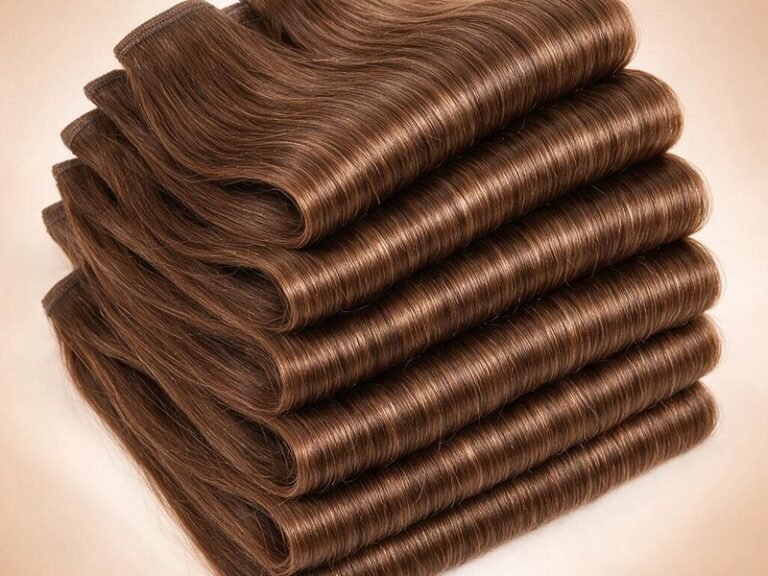
Start with the cuticle. Cuticle aligned means every strand’s outer scales run root to tip, so hair doesn’t catch or mat. Remy hair is human hair kept cuticle aligned, while virgin hair is unprocessed and undyed. Run fingers down a bundle and back up; aligned hair stays smooth, while stripped hair feels squeaky in reverse. Good machine wefts are thin, uniform, and reinforced, with nothing pulling free under a gentle tug.
What should weft hair cost at wholesale?
Wholesale weft hair usually runs $15–$25 for 10–14 inches, $25–$40 for 16–22 inches, and $40–$60+ for 24–30 inches per bundle at MOQs of 10–50 pieces. A bundle weighs about 100 grams, or 3.5 ounces. Raw single-donor hair from named origins costs more because supply is tight and texture isn’t steamed in. Under $10 a bundle usually means synthetic blend, fallen hair, or cuticle-stripped stock. Cheaper works for short-wear styles, but don’t resell it as premium virgin hair.
How many bundles do I need for a full sew-in?
For a full sew-in, use 3 bundles for 10–16 inches, 3–4 for 18–24 inches, and 4 or more past 26 inches. Longer bundles thin near the ends because hair is sold by weight, so extra tracks keep the bottom full. At roughly 100 grams each, a full head is about 300–400 grams before leave-out. Add one bundle for volume or a blunt cut rather than guessing with two. A closure (small lace top piece) or frontal (ear-to-ear hairline strip) changes the layout but not the total much.
Red flags I’d walk away from
- “100% virgin Remy” at $7 a bundle with no minimum isn’t real aligned human hair.
- Heavy silicone coating feels slippery now, then washes out after one shampoo and tangling starts.
- Bundles differ in texture, color, or curl pattern, signaling mixed donors and poor sorting.
- The weft sheds under a brush, or stitching looks wide, crooked, or glued instead of sewn.
- No samples, no named origin, or friends-and-family payment only with no paper trail.
MOQs, lead times, and ordering like you mean it
Reliable factories usually set MOQs of 10–50 bundles per texture or length; samples run 1–3 pieces near retail price. Stock colors and straight or body-wave textures ship in 3–7 days, while custom color takes 2–4 weeks, longer around holidays. Sample first, wash and heat-style it, and buy in bulk once the weft holds up. If you’re lifting blonde, our wholesale sourcing mistakes guide covers over-processing that dries bundles out. Then compare hair extensions by category and keep reorder SKUs consistent.
Quick buyer questions
Machine weft or hand-tied weft — which should I stock?
Machine wefts are thicker, more durable, and cheaper, so they’re the safer default for sew-ins and salon volume. Hand-tied wefts lie flatter for beaded rows, but cost more and can shed if cut. Stock both only if clients already ask for beaded rows; otherwise start with machine.
Can weft hair be colored and heat-styled?
Virgin cuticle-aligned hair can be lifted and toned, but dark-to-blonde work risks dry ends and shorter wear. Heat styling around 300–350°F with protectant is fine; repeated high heat dries any human hair. For a blonde-heavy shop, order factory-colored bundles instead of lifting each batch.
If you’re comparing suppliers, check the policies in our FAQ and order one sample bundle before a full run. Good wefts aren’t the cheapest on the sheet — they’re the ones clients reorder without complaints.
Send Us Your Hair Inquiry
Need bulk pricing, samples, or a private-label quote? Fill in the form and our team will get back to you within one business day.