Selling to Beauty Supply Chains: How to Get Your Hair on Their Shelves
We talk to at least a dozen new hair brand owners every month who say selling to beauty supply chains and landing shelf space is their biggest annual goal, and most walk in with the same wrong assumption: that the lowest price wins. It doesn’t.
I’ve sat in on enough buyer meetings over the last 9 years to tell you straight—chain buyers care far more about consistent supply, low return rates, and packaging that doesn’t cause headaches for their store staff than they do about saving $2 a bundle. You can undercut every other vendor on price by 10% and still get passed over if you show up unprepared.
First rule for selling to beauty supply chains: Ditch the unbranded samples
I can’t tell you how many vendors walk into buyer meetings with loose bundles stuffed in plain ziplock bags, no UPC, no printed length or grade, no MSRP, no contact info. Chain buyers see 20+ pitches a week. If your sample doesn’t look ready to go straight on a shelf the second you hand it over, it goes straight in the trash can under their desk before you even leave the room.
You don’t need fancy $5 per unit rigid luxury boxes to impress them, either. That’s overkill for beauty supply price points, and it will make your wholesale price too high to move. What you do need is a sturdy, hangable poly bag, a clear hang tag with length (marked in inches), weight (marked in grams), texture, hair origin, and care instructions, plus a scannable UPC code. All in, that runs about $0.75 per unit, and it’s the bare minimum to be taken seriously.
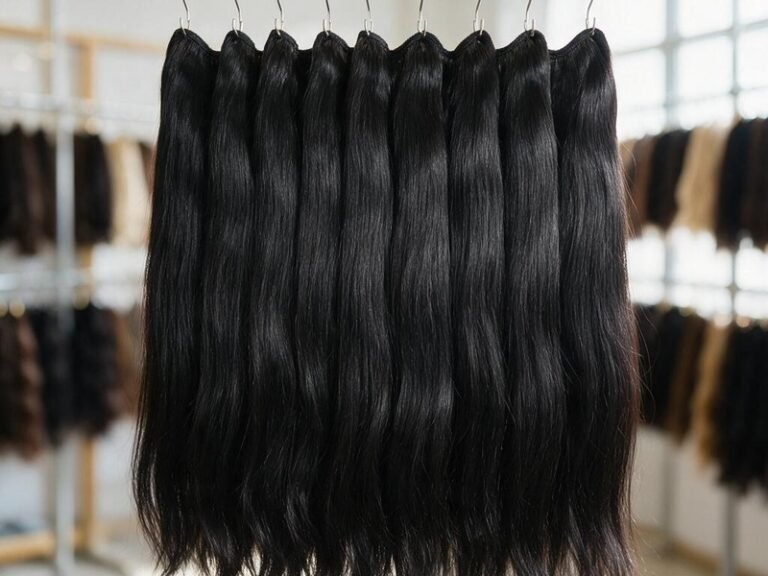
Most regional chains start with a core set of 8-12 SKUs: 10-22 inch straight, body wave, and deep wave in natural black, plus a small run of 613 blonde for their higher-volume locations. If you’re sourcing core stock, weft hair extensions are the non-negotiable base, since they’re easy for store staff to restock and familiar to every beauty supply shopper.
MOQs aren’t there to shut you out
I hear new vendors complain all the time that chain MOQs are designed to keep small brands out. That’s not true. Buyers don’t set high minimums to be bullies—they set them because they can’t afford to run out of a top-selling SKU on a Saturday, when 70% of their weekly hair sales happen.
Most mid-sized regional chains (10-30 locations) won’t ask for a 10,000 unit MOQ out the gate, but they will expect you to hold 30 days of safety stock for each SKU you place. For a standard 100g weft bundle, that works out to roughly 40 units per length per texture for a 15-store chain. That’s not a huge number if you plan for it, but it’s a non-starter if you’re used to dropshipping 5 orders a day out of your garage.
If you can’t cover a reorder in 7 business days or less, they’ll drop you faster than a bad batch of shedding hair. Last year we saw a small brand lose a 22-store regional account because they ran out of 18 inch body wave for 3 weeks during back-to-school season, the busiest hair buying window of the year. This is exactly why we always tell new wholesale clients not to abandon their direct-to-consumer sales entirely when they land a chain account—running DTC alongside wholesale gives you a buffer to move excess stock if a chain trims their order last minute, so you’re not stuck holding thousands of dollars of inventory you can’t move.
Your hair quality only needs to be consistent, not perfect
I know that sounds counterintuitive, but think about it. Beauty supply shoppers aren’t paying $300 for salon-exclusive virgin hair that lasts a year. They’re paying $45-$85 a bundle, and they expect that hair to last 4-8 weeks with proper care, no excessive shedding, no weird chemical smell when they open the bag.
The fastest way to lose an account is to send a first batch of hair that holds curl for two weeks, then follow it up with a reorder coated in thick silicone that mats after the first wash. You don’t need to splurge on top-tier 12A unprocessed hair for beauty supply shelves, either. That would price you out of the market entirely, and most shoppers won’t pay that premium in that setting.
But you do need to lock in a factory run that matches your sample exactly, batch after batch. We had a client a couple years ago who tried to cut costs by switching factories mid-year to save $1.20 a bundle, and the new hair had such a strong chemical dye smell that 18% of units were returned in the first month. The chain pulled all their product, and they’ve never been able to get a meeting with that buyer again. Consistency beats “best on the market” every single time.
If you’re building out your initial SKU set, don’t sleep on value-focused options like bulk hair for braiding too—those SKUs turn over 2-3x faster than premium bundles in most urban and suburban beauty supply locations, and buyers are always looking for a reliable braiding hair supplier that doesn’t send scratchy, tangly product.
The hidden costs no one warns you about
So many new vendors come in with a wholesale price calculated only on raw hair and packaging cost, then get a rude awakening when they see the final contract. There are standard, non-negotiable costs for every chain account, and you have to build them into your price from day one, or you’ll lose money on every order.
- Slotting fees: Most chains charge $50-$150 per SKU per location to put your product on the shelf, especially if you’re a new, unproven brand. That’s not a bribe—it covers shelf resets, POS system updates, and staff training for your product.
- Damage allowances: Almost every chain deducts 2-3% from every invoice to cover damaged, opened, or stolen units. You don’t get that money back, even if you can prove damage happened in their store.
- Promotional discounts: You’ll be expected to run 10-15% off promotions 2-3 times a year, usually during back-to-school, Black Friday, and prom season. Buyers plan these calendars 6 months out, so you’ll have plenty of heads up, but you need enough margin to absorb those cuts.
I’d suggest pricing your wholesale units so you make at least 35% margin after all those fees are taken out. That gives you breathing room for unexpected costs, like expedited shipping if a reorder runs late, or a batch of hair that fails quality check right before a ship date. If your margin is any thinner, one small mistake can put you in the red on the whole account.
The quick questions I get asked most often
After years of walking brands through this process, the same three questions come up in almost every call.
Do I need liability insurance to sell to chains?
Yes, almost every chain will require a $1M general liability policy that names them as an additional insured before you sign a contract. Those policies run $30-$50 a month for most small hair brands, so it’s not a huge cost, but it’s a box you have to check. Don’t wait until you have a buyer asking for it to sign up—getting the certificate can take 3-5 business days, and you don’t want to lose a deal waiting on paperwork.
How long does it actually take to get on shelves?
Don’t plan on a quick win. From your first cold email to seeing your product on shelves, the timeline is usually 6-9 months for a regional chain. You’ll send samples, do a pricing call, run a small 3-store test for 8-12 weeks to prove your turn rate (that’s how fast units sell after being restocked), then negotiate the full contract. If someone tells you they can get you into a national chain in 30 days, they’re selling you a scam.
What if my first test run flops?
It happens. If your sell-through rate is below 20% in the test period, the buyer will probably pass on a full rollout, and that’s okay. Ask for honest feedback—was the price too high? Did the packaging get lost next to bigger brands? Was the texture not a fit for their customer base? Most buyers will give you straight feedback if you ask politely, and you can use that to adjust your pitch for the next chain. You don’t get blacklisted for a bad test run; you get blacklisted for making excuses instead of fixing the problem.
Landing that first beauty supply account isn’t about having the buzziest social media brand or the cheapest hair on the market. It’s about showing up prepared, pricing for all the real costs, and proving you can show up reliably, every single reorder.
If you’re still building out your initial product line to pitch buyers, you can browse our full stock to see core SKUs that consistently perform in beauty supply locations, and reach out to our team for wholesale pricing and sample orders. We’ve helped dozens of small brands go from local salon sales to regional shelf placement, and we can talk you through the exact SKU mix that works for the chains in your area.
Send Us Your Hair Inquiry
Need bulk pricing, samples, or a private-label quote? Fill in the form and our team will get back to you within one business day.